
Texas Instruments H-Bridge Motor Driver 1A - SN754410. H-Bridge Motor Driver 1A - SN754410 Faster, cheaper, smaller, better, right?
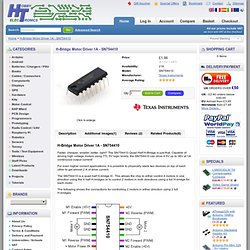
The SN754410 Quad Half H-Bridge is just that. Capable of driving high voltage motors using TTL 5V logic levels, the SN754410 can drive 4.5V up to 36V at 1A continuous output current! For even higher current applications, it is possible to physically stack two devices on top of each other to get almost 2 A of drive current. The SN754410 is a quad half H-bridge IC.
The following shows the connections for controlling 2 motors in either direction using 2 full H-bridges. Documents: SN754410 Datasheet Stepper Motor drive from Arduino using SN754410 PiNE | Bought two of these to control two 50:1 gearmotors (also from Hobbytronics). The schematic for using these chips shown on this site (and on most others presented on the web) shows a single chip controlling two motors. (The web page quoted actually goes further: by piggy backing an extra SN754410 onto each chip, giving 4.4A per channel. Bangz | Showing 1 to 2 of 2 (1 Pages) Sandwich, The Line-Following Robot. A simple line Follower Sandwich is a fantastic robot that came about because I wanted a small uncomplicated line-following robot.

Sweet! Has been a very popular attraction on this website, but Sweet is too difficult to build and program for most hobbyists. However, Sandwich is a robot you can make at home from scratch without a kit. Or, if you prefer, you can obtain a printed circuit board or a full kit for sake of convenience. Sandwich won second place out of 14 robots at the Chicago line-following competition Even though Sandwich is much simpler than Sweet, there are a number of concepts that carried over: Flashing lights LEGO slide-on wheels Ability to follow either light or dark paths Encased body (but a commonly available Ziploc sandwich container instead of m&m’s racing tin) Sandwich actually exceeds Sweet in a few regards: Smaller Lighter Much quieter Less expensive Twice the speed Only one circuit board instead of three No programming -- just an off-the-shelf comparator chip Sensors.
Need help with TSOP 1738 sensor. Like colin mac said, your 555 timer gives just below 25khz.

Try: C = 10nf (0.01uF) ten times smaller than you have now R1 = 1.8k R2 =1k These should be very easy to find (all are standard E12 values) and give 37.97kHz. The TSOP has a very narrow response bandwidth, you need to be at 38kHz +/- a kHz or two at most. Question for the forum: does duty cycle matter at all in this application? I should think it gets lowpassed by the sensor and it wouldn't matter, but I might be wrong. TSOP 1738 Photo module Design notes. TSOP 17… Series Photomodules are excellent Infrared sensors for remote control applications.

These IR sensors are designed for improved shielding against electrical field disturbances. TSOP 1738 Photo module Design notes TSOP 17…. Series Photomodules are miniature IR sensor modules with PIN photodiode and a preamplifier stage enclosed in an epoxy case. Its output is active low and gives +5 V when off. Inside the Photo module The photo module has a circuitry inside for amplifying the coded pulses from the IR transmitter. Pin assignment Photomodules are 3 pin devices. The pin assignment (Front view) of some common Photomodules Type pins 1 2 3 Response frequency TSOP 1730 G 5V OP 30 kHz TSOP 1736 G 5V OP 36 kHz TSOP 1738 G 5V OP 38 kHz TSOP 1756 G 5V OP 56 kHz TSOP 1236 G 5V OP 36.7 kHz TSOP 1838 OP G 5V 38 kHz TSOP 1138 G 5V OP 38 kHz TK 1836 OP G 5V 36 kHz SFH 506-38 G 5V OP 38 kHz RPM 7238F OP G 5V 37.9 kHz Design considerations Photo module design is given in Fig.2.
DA09S Digital Position Indicator · SIKO Products USA. Basic device with 5 decades Profile DA09S: Most-used size in slim design Hollow shaft, max.

Ø 20 mm Counter with 5 decades and fine reading Display can be designed for “mm” or “inch” Magnifying function for good readability Stainless-steel driving shaft as an option Axial seal, dustproof and splash-proof Clamping plate (see accessories) Add to leaflet.