
The Behavioral Sink. Cabinet and the author regret that a previous version of this article omitted its sources.
To readers who are interested in learning more about Calhoun's research, we highly recommend "Escaping the Laboratory: The Rodent Experiments of John B Calhoun and Their Cultural Influence" by Edmund Ramsden and Jon Adams, LSE Department of Economic History, 2008, to which this article is indebted. How do you design a utopia? In 1972, John B. Fasting triggers stem cell regeneration of damaged, old immune system. In the first evidence of a natural intervention triggering stem cell-based regeneration of an organ or system, a study in the June 5 issue of the Cell Stem Cell shows that cycles of prolonged fasting not only protect against immune system damage — a major side effect of chemotherapy — but also induce immune system regeneration, shifting stem cells from a dormant state to a state of self-renewal.
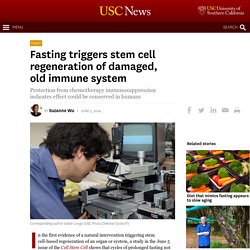
In both mice and a Phase 1 human clinical trial involving patients receiving chemotherapy, long periods of not eating significantly lowered white blood cell counts. In mice, fasting cycles then “flipped a regenerative switch,” changing the signaling pathways for hematopoietic stem cells, which are responsible for the generation of blood and immune systems, the research showed. The study has major implications for healthier aging, in which immune system decline contributes to increased susceptibility to disease as people age. Fasting cycles More stories about: Diet, Stem Cells. STAN LEE SUPERHUMANS - SUPERSIGHT. "Functional polarity" of the spinal cord caused... [Am J Physiol. 1984] Physiology of Breath-Hold Diving and the Ama of Japan.
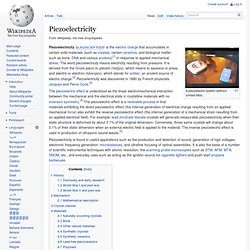
Piezoelectricity. A piezoelectric system (without contact tabs) Piezoelectricity is found in useful applications such as the production and detection of sound, generation of high voltages, electronic frequency generation, microbalances, and ultrafine focusing of optical assemblies.
It is also the basis of a number of scientific instrumental techniques with atomic resolution, the scanning probe microscopies such as STM, AFM, MTA, SNOM, etc., and everyday uses such as acting as the ignition source for cigarette lighters and push-start propane barbecues. History[edit] Discovery and early research[edit] One-nm-thick graphene engine mimics two-stroke engine. (Phys.org) —It may sound impossible that a 1-nm-thick piece of graphene—made of just a single layer of carbon atoms and containing some chlorine and fluorine atoms—can function as a two-stroke combustion engine.

After all, on the macroscale, two-stroke engines are often used to power devices such as chainsaws and motorcycles. Although the nanoscale version is also very powerful, its potential applications in next-generation nanodevices would of course be very different. Although micro/nano engine designs are often inspired by macroscopic engines, this is the first nanoscale engine that mimics an internal combustion engine, despite the widespread use of two- and four-stroke engines since the 19th century. Researchers Jong Hak Lee, et al., from Prof. Barbaros Özyilmaz' group at the Graphene Research Center at the National University of Singapore, have published a paper on the tiny graphene engine in a recent issue of Nano Letters. New research sheds light on how the body regulates fundamental neuro-hormone. 11-Feb-2014 [ Print | E-mail ] Share [ Close Window ] Contact: Philippa Walkerphilippa.walker@bristol.ac.uk 44-117-928-8086University of Bristol New research has revealed a previously unknown mechanism in the body which regulates a hormone that is crucial for motivation, stress responses and control of blood pressure, pain and appetite.

The breakthrough could be used to design drugs to help fight health problems connected with these functions in the future. Researchers at the University of Bristol and University College London found that lactate – essentially lactic acid – causes cells in the brain to release more noradrenaline (norepinephrine in US English), a hormone and neurotransmitter which is fundamental for brain function.
1Ja8X1c.gif (360×273) Redirect Notice. Pinch of platinum gives white organic LEDs › News in Science (ABC Science) News in Science Monday, 7 October 2013 Darren OsborneABC Bright light A team of scientists have developed a plastic-like polymer that emits white light more efficiently than current organic LEDs.

In recent years household lighting has moved from the incandescent light bulb to the compact fluorescent, and more recently to LEDs. But to create white light manufacturers cluster red, green and blue LEDs, or use blue LED light, some of which is converted to yellow, and then mixing the two colours to create white light. Richard Feynman Interview If you have kids or plan to have kids, watch this.flv. Bee Venom Destroys HIV And Spares Surrounding Cells. Nanoparticles loaded with bee venom kill HIV. Nanoparticles carrying a toxin found in bee venom can destroy human immunodeficiency virus (HIV) while leaving surrounding cells unharmed, researchers at Washington University School of Medicine in St.
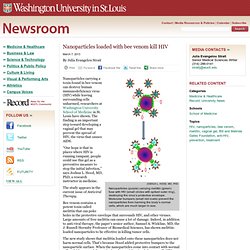
Louis have shown. The finding is an important step toward developing a vaginal gel that may prevent the spread of HIV, the virus that causes AIDS. Geneticists evolve fruit flies with the ability to count. Eulerian Video Magnification. Landmark calculation clears the way to answering how matter is formed. Get Set: A Jet To Replace Needles For Injections : Shots - Health Blog. The needle and syringe are icons of modern medicine.

But a device developed at MIT to squirt medicines quickly and pretty much painlessly through the skin suggests that the future of medicine could be needle-free. The idea is to shoot an extremely thin, extremely fast jet of medicine straight through skin and into muscle. "It's sort of like a laser beam," project leader and mechanical engineering professor Ian Hunter tells Shots. But because the jet is so thin — he compares it to a mosquito's proboscis — it's unlikely to produce much pain. Details of the prototype are published in the journal Medical Engineering and Physics. From lemons to lemonade: Reaction uses carbon dioxide to make carbon-based semiconductor.
(Phys.org) -- A materials scientist at Michigan Technological University has discovered a chemical reaction that not only eats up the greenhouse gas carbon dioxide, it also creates something useful.

And, by the way, it releases energy. Making carbon-based products from CO2 is nothing new, but carbon dioxide molecules are so stable that those reactions usually take up a lot of energy. If that energy were to come from fossil fuels, over time the chemical reactions would ultimately result in more carbon dioxide entering the atmosphere—defeating the purpose of a process that could otherwise help mitigate climate change. Sugar makes you stupid: Study shows high-fructose diet sabotages learning, memory.
Attention, college students cramming between midterms and finals: Binging on soda and sweets for as little as six weeks may make you stupid.
A new UCLA rat study is the first to show how a diet steadily high in fructose slows the brain, hampering memory and learning — and how omega-3 fatty acids can counteract the disruption. Transparent Aluminum. Those of you, um, enthusiastic enough to remember Star Trek IV may recall the scene embedded above. If not, let me set up the clip: The crew of the Enterprise has gone into the past to retrieve some whales, OK? Cascade Creature. Clara M. Davis and the wisdom of letting children choose their own diets. News - Magnetic bacteria may help build future bio-computers. 7 May 2012Last updated at 05:40 ET Tiny magnets form inside magnetic bacteria Magnet-making bacteria may be building biological computers of the future, researchers have said.
Italy scientists say they have found oldest human blood. Armadillidium. Towards a new test of general relativity? Scientists funded by the European Space Agency have measured the gravitational equivalent of a magnetic field for the first time in a laboratory. Under certain special conditions the effect is much larger than expected from general relativity and could help physicists to make a significant step towards the long-sought-after quantum theory of gravity.
Through a glass, clearly. Safely Preserving Eggs. Flying object propels itself by flipping inside out.