CHEWA PEOPLE: THE GREAT MATRIARCHAL BANTU PEOPLE OF AFRICA AND THEIR ANCIENT NYAU SECRET SOCIETY. "Akuluakulu ndi m'dambo mozimila moto," (The elders are rivers where fire is extinguished').
Chewa Proverb. Chewa people of Malawi The Chewa people are matriarchal Bantu-speaking ethnic group living Central, East and Southern Africa. They are found in Malawi (where they are predominant), Mozambique, Zambia, and Zimbabwe. The Chewa are closely related to people in surrounding regions such as the Tumbuka and Nsenga. Nyau dancer in Waenera village. There are two large Chewa clans, the Phiri and the Banda. Chewa Nyau dancers at the 2012 Kulamba Traditional Ceremony, Katete. Geography/Ecology: Chewa are located in Malawi 13° 30' S and 34° 00' E; Zambia 15° 0' S and 30° 0 ' E; Mozambique 18° 15' S and 35 ° 00' E (19).
Chewa village,Malawi Drainage in the area is good.
For the zombies. Haiti: List of Loa. Afro-American religion. Afro-American religions (also known as African diasporic religions or New World traditions) are a number of related religions that developed in the Americas among enslaved Africans in various countries of Latin America, the Caribbean, and parts of the southern United States.
They derive from African traditional religions (especially of West and Central Africa) and Indigenous American traditions and beliefs. Characteristics[edit] List of traditions[edit] Other closely related regional faiths include: New religious movements[edit] Most new religious movements are void of these traditional pre-Abrahamic African beliefs. A second wave of new movements originated in the 1960s to 1970s, in the context of the emergence of New Age and Neopaganism in the United States: Louisiana Voodoo. "New Orleans Voodoo" redirects here.
For US Arena Football League team, see New Orleans VooDoo. Louisiana Voodoo, also known as New Orleans Voodoo, describes a set of spiritual folkways which originated from the traditions of the African diaspora. It is a cultural form of the Afro-American religions developed by French, Spanish, and Creole population of the U.S. state of Louisiana. Voodoo is one of many incarnations of African-based spiritual folkways rooted in West African Dahomeyan Vodun.
Its liturgical language is Louisiana Creole French, language of the Louisiana Creole people. History[edit] African influences[edit] Gris-gris by Charles Gandolfo Voodoo was brought to French Louisiana during the colonial period by workers and slaves from West Africa, and then again, by slaves and free people of color who were among the refugees from the Haitian revolution. The enslaved community quickly outnumbered white colonists. Akodessewa Fetish Market - The Biggest Voodoo Market in the World. Togo’s Akodessewa Fetish Market is recognized as the largest fetish market in the world, a place where Voodoo practitioner can find anything they need for their rituals.
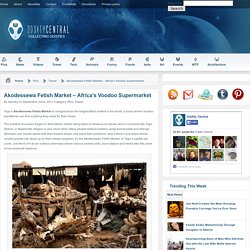
The practice of voodoo began in West Africa, before being taken to America by slaves, and in countries like Togo, Ghana, or Nigeria the religion is very much alive. Many people believe healers using animal parts and strange talismans can invoke spirits with their bizarre rituals, and solve their problems. And if there’s one place where voodoo priests can stock up on their creepy supplies, it’s the Akodessewa Fetish Market, in Togo’s capital city, Lome. Just think of it as an outdoor pharmacy where various animal parts, bone statues and herbs take the place of conventional medicine.
Photo credits Photo credits Couples that can’t have babies, goalkeepers who want to do wonders in a football match, people who want extra stamina to run a marathon, they can all be helped at the world’s biggest voodoo market. Photo credits Reddit. Lwa (Vaudou) Un article de Wikipédia, l'encyclopédie libre.
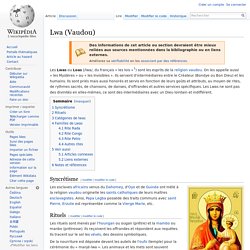
Les Lwas ou Loas (/lwa/, du français « les lois »[1]) sont les esprits de la religion vaudou. On les appelle aussi « les Mystères » ou « les Invisibles ». Ils servent d'intermédiaires entre le Créateur (Bondye ou Bon Dieu) et les humains. Houngan. Bokor. Un article de Wikipédia, l'encyclopédie libre.
Description[modifier | modifier le code] Les bokors figurent dans plusieurs contes haïtiens et sont souvent associés à la création de zombis à l'aide d'un breuvage ou d'une potion qui plonge dans un état de catalepsie donnant l'apparence de la mort, contenant généralement des poisons à des doses sub-mortelles (extraits de tétraodon et stramoine notamment). Dans ces légendes, cette potion donne l'impression que le buveur est mort, à la suite de quoi il est enterré. Quelques jours plus tard, le bokor revient chercher le "cadavre" et le force à agir suivant sa volonté, par exemple pour le travail manuel.
La personne est, cependant, tout à fait vivante mais dans un état de conscience dissocié dans lequel elle ne peut pas maîtriser ce qu'elle dit ou fait. Zombie (mort-vivant) Un article de Wikipédia, l'encyclopédie libre.
Pour les articles homonymes, voir Zombie. Zombie Groupes de zombies selon la vision moderne. Créature Origines. Vévé. Un article de Wikipédia, l'encyclopédie libre.
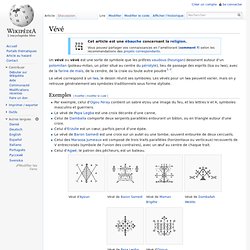
Un vévé ou vèvè est une sorte de symbole que les prêtres vaudous (houngan) dessinent autour d'un potomitan (poteau-mitan, un pilier situé au centre du péristyle), lieu de passage des esprits (loa ou lwa), avec de la farine de maïs, de la cendre, de la craie ou toute autre poudre[1],[2]. Le vévé correspond à un lwa, le dessin réunit ses symboles. Les vévés pour un lwa peuvent varier, mais on y retrouve généralement ses symboles traditionnels sous forme stylisée.