
Assignment 2. LoadImage() \ Language (API) \ Processing 1.0. John Conway's Game of Life. The Game The Game of Life is not your typical computer game.
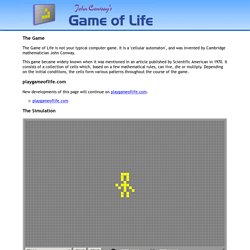
It is a 'cellular automaton', and was invented by Cambridge mathematician John Conway. This game became widely known when it was mentioned in an article published by Scientific American in 1970. It consists of a collection of cells which, based on a few mathematical rules, can live, die or multiply. Depending on the initial conditions, the cells form various patterns throughout the course of the game. playgameoflife.com New developments of this page will continue on playgameoflife.com. playgameoflife.com The Simulation Figure from the XKCD RIP John Conway comic.
The Rules For a space that is 'populated': Each cell with one or no neighbors dies, as if by solitude. Each cell with four or more neighbors dies, as if by overpopulation. Each cell with two or three neighbors survives. For a space that is 'empty' or 'unpopulated' Each cell with three neighbors becomes populated. The Controls Development Edwin Martin <edwin@bitstorm.org>
Processing. TYPOTOPO. The Gestalt Principles. The Gestalt Principles Gestalt is a psychology term which means "unified whole".
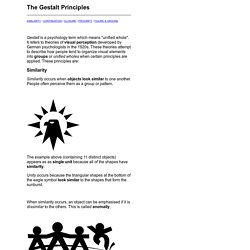
It refers to theories of visual perception developed by German psychologists in the 1920s. These theories attempt to describe how people tend to organize visual elements into groups or unified wholes when certain principles are applied. These principles are: Similarity Similarity occurs when objects look similar to one another. The example above (containing 11 distinct objects) appears as as single unit because all of the shapes have similarity.
Unity occurs because the triangular shapes at the bottom of the eagle symbol look similar to the shapes that form the sunburst. When similarity occurs, an object can be emphasised if it is dissimilar to the others. The figure on the far right becomes a focal point because it is dissimilar to the other shapes. Continuation Continuation occurs when the eye is compelled to move through one object and continue to another object. Closure Examples Proximity Figure and Ground Figure. The Nature of Code. My CMYK Images Change When I Print or Export PDF! [Note that this article originally appeared in InDesign Magazine, Issue 37.

For a free sample issue of InDesign Magazine, or for subscription information, see www.indesignmag.com] If you are going to use CMYK images from Photoshop in your InDesign documents, there are some things you need to know. Unless you understand the pitfalls, they’ll cause you untold grief sooner or later. The genesis of this article was a problem posed to me by a production editor at a major book publisher (let’s call her Liz) who couldn’t figure out a mystery involving a book she was preparing for print: While some CMYK images from Photoshop were showing up in the final PDF files correctly, others–the majority, in fact–were changing.
The numbers inside the CMYK image were changing dramatically–for example, a 80-percent black would change into 50-percent black with a bunch of cyan, yellow, and magenta thrown in. So here are some lessons learned, and advice I can offer. CMYK Is Not Bad The Danger of Cross Rendering. Flong - Interactive Art by Golan Levin and Collaborators.