
"Bound to Please: A History of the Victorian Corset" "Appropriat[ing] Dress: Women's Rhetorical Style in 19th c. America" "The Corset" Review. Third-wave feminists waving copies of Naomi Wolf's The Beauty Myth once proclaimed that men had hatched an ominous conspiracy to trick women into pursuing an impossible beauty ideal rather than real social progress.

In The Corset: A Cultural History, Valerie Steele lays waste to that doctrine by documenting the extent to which women, not men, have historically policed the ideals of femininity, often in spite of the objections of bewildered men. No Victoria's Secret bimbo, Steele is serious about her subject. In her hands, the history of fashion is treated as a study of the intersection of beauty ideals with new technologies that enable them. Chief curator at the Fashion Institute of Technology in New York, Steele teamed up with cardiologist Dr. Corsets. A drawing of a luxury hourglass corset from 1878, featuring a busk fastening at the front and lacing at the back A corset is a garment worn to hold and shape the torso into a desired shape for aesthetic or medical purposes (either for the duration of wearing this item, or with a more lasting effect).

Both men and women are known to wear corsets, though women are more common wearers. Etymology[edit] Advertisement of corsets for children, 1886 Advertisement of corsets for men, 1893. Historical Scope of the Corset. The corset has been an important article of clothing for several centuries, evolving as fashion trends have changed.
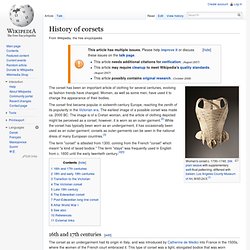
Women, as well as some men, have used it to change the appearance of their bodies. The History Of Corsets. Corset Evolution by Waist Placement. Definition A corset is a close-fitting piece of clothing that has been stiffened by various means in order to shape a woman's (also a man's, but rarely) torso to conform to the fashionable silhouette of the time.
The term "corset" only came into use during the 19th century; before that, such a garment was usually referred to as a pair of bodies, a stiff bodice, a pair of stays or, simply, stays. In French 18th century texts (e.g. Garsault, Diderot), you can find the term corset as referring to a lightly stiffened bodice with tie-on sleeves, whereas proper stays are called corps. Renaissance and Baroque. Mini History of the Corset. In the 1830's, the corset was thought of as a medical necessity.

It was believed that a woman was very fragile, and needed assistance from some form of stay to hold her up. Even girls as young as three or four, and probably directed by the best motives, were laced up into bodices. Gradually these garments were lengthened and tightened. Corset History. The following is a short history of the 20th century corset, which I have wanted to write as a record of my continuing fascination with the use of corsetry as a means of altering the natural shape of the body.

The corset is a particularly interesting garment, as it has symbolism and power over and above the merely utilitarian aspect of modifying the bodies contour. From one perspective the corset can be viewed as being a symbol of male dominance over women, as in the past the dictates of male dominated fashion have often required women to wear constricting and uncomfortable garments, to force them to adopt a shape dictated by society rather than a natural one.
It has always fascinated me why women would have been prepared to endure such discomfort, which as well as causing physical problems in extreme cases, must by its very nature have been debilitating over a period of time. Corsets have existed for centuries and can be traced back to Greek and Minoan times. Modern Corsetry. 1908 Corset Photo. Maternity Corsets. Physicians concerned about public health focus their attention on curtailing preventable risks to health, not only infectious diseases but also harmful behaviors.

A hundred years ago Western physicians were fighting to eliminate a particular risk to women’s health—the corset, an undergarment once worm by most Western women (and some men). Artfully designed clothing alters how the body looks, but the corset dramatically changes basic body shape. 500 Years Corsets have been common in Western society for the past 500 years. They are fabric garments that constrict the torso.
Reinforced with stiffeners, they fit so tightly that the body is molded into the desired shape. The shape was originally architectural, making a woman’s torso a straight-sided, inverted cone. Men's Corsets. Children's Corsets. Diary of a Young Girl. Brief Explanation of Children's Corsets. About Corsets: A Short Essay to Answer Some Frequently Asked Questions Andrea Johnson.

Long Corset. Shifting Contours. Corset Making. Exploring the Corset – Day 5 Corset making in centuries past, was serious business.

Corset or stay making was considered heavy work and therefore not appropriate for women. All corsets were made by men/tailors. Tailoring was also a heavy job, the “pressing” was considered too difficult a task for a woman.France imposed many restrictions on fashion and trade. Raw Materials, Design, Manufacturing. Background The corset is an undergarment traditionally made of stiffened material laced tight to the body in order to slim a woman's waist.

Evidence shows that some type of waist-cinching garment was worn by Cretan women between 3000 and 1500 B.C. , but narrow waists became the fashion among women in Europe during the Middle Ages. Corset-making Materials. Materials.

Bifid Corset Busk. Corsetmaker. Fainting Rooms: Constraints. A fainting room was a private room, of which its main features/furniture were fainting couches, used during the Victorian era, to make women more comfortable during the home treatment of female hysteria. Fainting rooms were used for more privacy during home treatment pelvic massages. Such couches or sofas typically had an arm on one side only to permit easy access to a reclining position, although the sofa style most typically featured a back at one end so that the resulting position was not purely supine. Physical Constraints. Physical Constraint: Ribs.
Constraint on Organs. Class Distinctions for Corsets. Did Poor Women Wear Corsets? Tight Corsets= Power and Wealth. Advertisements. Historic Corset ADS. More Corset Ads. Corset Advertisements from 1900s. Corset advertisements. Early 20th c. RUBBER Corset ads. Whilst compiling the fascinating recollections of the famous Spencer corsetiere, Alison Perry, she made a response to a question about rubber corsetry. I have copied the response since it inspired me to add an extra page to this site. On the right (above) is the genuine article. One does not come across these very often since rubber naturally degrades in sunlight and in contact with any oils including perspiration. Rubber corsetry was rarely referred to as such. Contemporary Corsets: Mr. Pearl. “The gentleman who has the pleasure of tying the final bow owns you.” - Mr.
Pearl, interview What strikes me about fetish legend/corsetier Mr. Pearl’s images is how much he looks like a true English gentleman – and how, magically, his 18-inch corseted waist works to enhance that image, the opposite of what one might expect it to do. Mr. Pearl grew up in South Africa and moved to London at the earliest chance after completing his military service. Fast-forward to the 2000s: Mr. Pearl & his creations.
Despite his success, Pearl doesn’t have a flashy website. “Activities like Pearl’s involve a transfiguration of the self, a metaphysical transaction between self and other in which flesh is deformed to be perfected, as a saint is perfected in martyrdom. Pearl by Ali Mahdavi, 1999 In interviews, Peral makes it clear that he feels today’s obsession with hyper-convenience has detracted from our appreciation of the sublime, which to him corsetry embodies. Ethel Granger. By her husband, WILLIAM A GRANGER More pictures on LISA Apropos to the above, Terry sends these personal memories, which may be of tangential interest: "I meet Ethel Granger about 1960 when I was a school boy in Peterborough, UK. I met her because her husband was a local astronomer and I was interested in astronomy.
Historical Corsets to Contemporary Erotica. EthelGrainger. Cathie Jung: More pics of Corset Queen. 2010: "The Corset Queen" Belting as a Corset Function. Sources: Striped top – Banana Republic, hand me down Dress – thrifted and chopped by me Belt – thrifted Tights – TJMaxx Pendant – Anthropologie (the original chain broke and I thrifted a ‘new’ chain for it) Loafers – Michael Kors, thrifted Bike – 1970s Peugeot Mixte. Contemporary Artistic Corset Remix Pic.