
Homemade Hair Treatments - At Home DIY Hair Treatments. Eggs, yogurt and honey are, at first glance, all components of a tasty breakfast—but they also happen to be hair treatment ingredients, and affordable, all-natural ones at that.

And they're not the only ones. Did you know, for instance, that the oils in avocados more closely resemble our own skin's oils than any product in the beauty aisle does? Or that the mild acidity in lemon is an effective—and gentler—alternative to chemical-laden products? Next time your locks need a lift, save money by using one of these kitchen fixes. For All Hair Types "The [raw] egg is really the best of all worlds," says Janice Cox, author of Natural Beauty at Home. To Use: For normal hair, use the entire egg to condition hair; use egg whites only to treat oily hair; use egg yolks only to moisturize dry, brittle hair, Cox says.
Photo by Shutterstock. For Dull Hair To Use: Massage 1/2 cup sour cream or plain yogurt into damp hair and let sit for 20 minutes. How to Make Your Own Beauty Products from Scratch. Let's keep things simple this week.

When it comes to personal-care products, we are big believers in streamlining what you use—see "Eight Products You Think You Need But Don't" for a refresher—buying less in general, and getting creative. We have both always loved experimenting in our kitchens and our bathrooms, checking ingredients in products we love, isolating the main ones, and then trying them on their own. Sometimes it works: A favorite hair leave-in contained aloe, for example, so one day we tried aloe alone and found that, lo and behold, it worked just fine on its own.
And sometimes it didn't. Over the years we have tried dozens of DIY beauty recipes to find ones we like—and that work. Simple body scrub Honey face wash We already told you about our new favorite homemade face wash last week but here's the recipe: In the palm of your hand, combine a tablespoon of raw, unfiltered honey with a half a tablespoon of baking soda, mix it together, and apply to damp skin.
Perfume Shave oil. Out of the ordinary Beauty Tips that work. Use toothpaste on yellow nails.
This usually happens when you let nail polish stay on your nails for very long and when you’ve used cheap nail polish. Whiten them all up by rubbing toothpaste to remove the stains. You can also add a few drops of lemon for extra whitening, it’s a natural bleaching agent. See other uses of lemon with this POST. Use suntan oil to treat damaged hair. Treat burns with milk. Powder Your Roots If by any chance you have no chance to jump into the shower and you need to look your best.
Cure Calluses with Vaseline or petroleum jelly It’s very unsightly to see hard calluses on your feet especially when you’ve been wearing closed shoes for a long time. Spot-Treat Smudges I find cotton tips very usual for this. Super-Glue a Nail Yikes! Buff with Baking Soda I’ve laughed at that episode in Friends when Ross went to a self-tanning sauna and got disastrous results.
Use Toothpaste on a Zit Use just a pea-size amount. Recipes. 12 Great Reasons To Start Alternate Nostril Breathing. “I rest well.
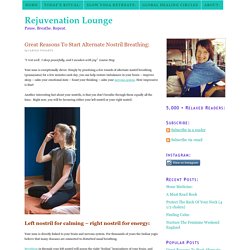
I sleep peacefully, and I awaken with joy” Louise Hay Your nose is exceptionally clever. Simply by practising a few rounds of alternate nostril breathing (pranayama) for a few minutes each day, you can help restore imbalances in your brain – improve sleep – calm your emotional state – boost your thinking – calm your nervous system. How impressive is that! Another interesting fact about your nostrils, is that you don’t breathe through them equally all the time. Left nostril for calming – right nostril for energy: Your nose is directly linked to your brain and nervous system. Breathing in through your left nostril will access the right “feeling” hemisphere of your brain, and breathing in through your right nostril, will access the left “thinking” hemisphere of your brain. Yogic breathing, the perfect relaxation tool: I happen to believe alternate nostril breathing is up there, as one of the most therapeutic calming rituals. 12 benefits of alternate nostril breathing: