
100 Terrific Mindhacks to Make the Most of Your Brain - Find Schools Online.com. For Sound Mental Health, Think Again About Your Thinking. Too much positive thinking You have surely heard a lot about positive thinking . Positive thinking gets good press. Everyone tells you to change your negative thoughts into positive ones.
But don't believe the hype. Positive thinking isn't quite the winner it claims to be. Accurate thinking is important because we know today, through the pioneering work of psychologists such as Albert Ellis, Aaron Beck and others, that your thoughts--the beliefs, interpretations and assumptions you make about yourself and the world around you--can shape your feelings and actions. Roughly sketched, our brain has two types of processes: control and automatic. These automatic processes we call habits. Moreover, a certain habit that has served us well in the past may outstay its welcome.
Our thoughts are, in essence, internal behaviors. Pop psychology may urge you to replace negative thought habits with positive ones. Is the process of replacing your distorted thought habits with healthy ones. Mental Heuristics Page. A heuristic is a "rule-of-thumb", advice that helps an AI program or human think and act more efficiently by directing thinking in an useful direction.

Some of these heuristics are age-old wisdom, bordering on cliche, but most are actually helpful. If you want something done, do it yourself Comment: Obviously true, and doing it is usually very good for your self esteem. A surprising amount of work can be done this way, and experts are not always necessary. However, there is a risk of becoming overworked if you try to do everything yourself - we all need other people after all.
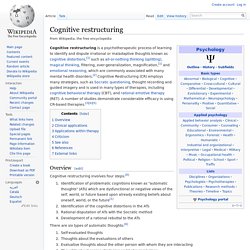
Cognitive restructuring. Overview[edit] Cognitive restructuring involves four steps:[6] Identification of problematic cognitions known as "automatic thoughts" (ATs) which are dysfunctional or negative views of the self, world, or future based upon already existing beliefs about oneself, world, or the future[1]Identification of the cognitive distortions in the ATsRational disputation of ATs with the Socratic methodDevelopment of a rational rebuttal to the ATs There are six types of automatic thoughts:[6] Self-evaluated thoughtsThoughts about the evaluations of othersEvaluative thoughts about the other person with whom they are interactingThoughts about coping strategies and behavioral plansThoughts of avoidanceAny other thoughts that were not categorized Clinical applications[edit] Applications within therapy[edit] Criticism[edit] See also[edit] References[edit] ^ Jump up to: a b c d Gladding,Samuel.Counseling:A Comprehensive Review.6th.Columbus:Pearson Education Inc, 2009.Jump up ^ Ryan C.
External links[edit]