
Semiotics. Semiotics frequently is seen as having important anthropological dimensions; for example, Umberto Eco proposes that every cultural phenomenon may be studied as communication.[2] Some semioticians focus on the logical dimensions of the science, however.
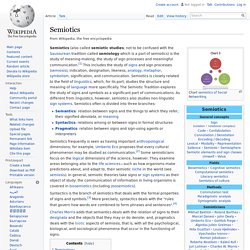
They examine areas belonging also to the life sciences – such as how organisms make predictions about, and adapt to, their semiotic niche in the world (see semiosis). In general, semiotic theories take signs or sign systems as their object of study: the communication of information in living organisms is covered in biosemiotics (including zoosemiotics). Syntactics is the branch of semiotics that deals with the formal properties of signs and symbols.[3] More precisely, syntactics deals with the "rules that govern how words are combined to form phrases and sentences".[4] Keys 2 Cognition - Cognitive Processes. 47.
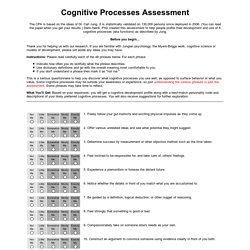
Trust what emerges from brainstorming. 48. Easily get in sync physically with people and things around you.
Cognition Disorders. Cognition and Emotions. Theories. Logic. Cognitive science. Cognitive science is the interdisciplinary scientific study of the mind and its processes.[1] It examines what cognition is, what it does and how it works.
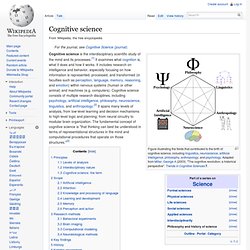
It includes research on intelligence and behavior, especially focusing on how information is represented, processed, and transformed (in faculties such as perception, language, memory, reasoning, and emotion) within nervous systems (human or other animal) and machines (e.g. computers). Cognitive science consists of multiple research disciplines, including psychology, artificial intelligence, philosophy, neuroscience, linguistics, and anthropology.[2] It spans many levels of analysis, from low-level learning and decision mechanisms to high-level logic and planning; from neural circuitry to modular brain organization. The fundamental concept of cognitive science is "that thinking can best be understood in terms of representational structures in the mind and computational procedures that operate on those structures.
Intelligence.