
Why We Should Think Big. Let’s think big!

We humans have repeatedly underestimated not only the size of our cosmos, but also our ability to understand and improve it. Over and over again, we’ve realized that everything we thought existed was merely a small part of a grander structure: our planet, solar system, galaxy, universe, and perhaps even one or more levels of multiverse.
How have we managed to understand so much about our cosmos even though it’s vastly larger than us? In part because it hides an elegant simplicity and beauty, revealed by mathematical shapes, patterns, and regularities that encode great predictive power. The Higgs Boson was predicted with the same tool as the planet Neptune and the radio wave were: with mathematics. But why does our universe seem so mathematical, and what does it mean? At first glance, our universe doesn’t seem very mathematical at all. About the author Related science friday link. Bobby Berberyan. We – Flash Engineers – rarely use these operators, but when we do, performance and efficiency are in mind.

Bitwise operators are used to manipulate bits of data/variables, they operate on single or sets/pairs of bits – otherwise known as bit patterns – at the level of their individual bits. There are two types of bitwise operations; bitwise operators and bitwise shifts. Bitwise Operators consist of the NOT, OR, XOR and AND. Bitwise Shifts consist of the Arithmetic, Logical, Rotary No Carry and Rotary Carry Through. One note on bitwise shifts is that they are sometimes considered bitwise operations, because they operate on the binary representation of its numberical value, but the bitwise shifts do not operate on pairs like the bitwise operators, and therefore cannot be considered bitwise operations, but bitwise nonetheless.
As indicated earlier, bitwise operators manipulate bits of unsigned integers. So let’s say we have these constant variables. Regular Expressions - A Gentle User Guide and Tutorial. A Regular Expression is the term used to describe a codified method of searching invented, or defined, by the American mathematician Stephen Kleene.
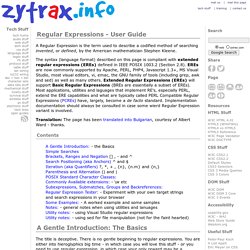
The syntax (language format) described on this page is compliant with extended regular expressions (EREs) defined in IEEE POSIX 1003.2 (Section 2.8). EREs are now commonly supported by Apache, PERL, PHP4, Javascript 1.3+, MS Visual Studio, most visual editors, vi, emac, the GNU family of tools (including grep, awk and sed) as well as many others. Extended Regular Expressions (EREs) will support Basic Regular Expressions (BREs are essentially a subset of EREs). Most applications, utilities and laguages that implement RE's, especially PERL, extend the ERE capabilities and what are typically called PERL Compatible Regular Expressions (PCREs) have, largely, become a de facto standard. Implementation documentation should always be consulted in case some wierd Regular Expression variant is involved.
Contents The title is deceptive. Simple Matching. ActionScript® 3 (AS3) API Reference. The ActionScript® 3.0 Reference for the Adobe® Flash® Platform contains the ActionScript language elements, core libraries, and component packages and classes for the tools, runtimes, services and servers in the Flash Platform.
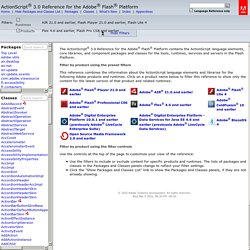
Filter by product using the preset filters This reference combines the information about the ActionScript language elements and libraries for the following Adobe products and runtimes. Click on a product name below to filter this reference to show only the content for the latest version of that product and related runtimes: Filter by product using the filter controls Use the controls at the top of the page to customize your view of the reference: Use the filters to include or exclude content for specific products and runtimes.