
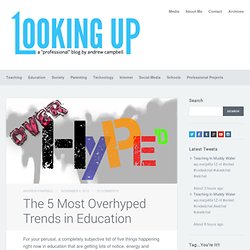
The 5 Most Overhyped Trends in Education « Looking Up. For your perusal, a completely subjective list of five things happening right now in education that are getting lots of notice, energy and resources but don’t deserve it, and why I think we need to reconsider our collective love affair with them: 1.
Flipping The Class: What is it? “…a form of blended Learning which encompasses any use of Internet technology to leverage the learning in a classroom, so a teacher can spend more time interacting with students instead of lecturing. This is most commonly being done using teacher created videos that students view outside of class time. What’s The Problem?
The problems with flipping are well explained in “The Flip: End of a Love Affair“. The short form is: What is it? What’s the problem? I’ve written before about the problems with BYOD. It’s inequitable. 3. What is it? The consistent message at ECOO12, from top thinkers and all corners, is that when considering using devices in education, pedagogy must come first. 4) 1 to 1: Technocratic Groupthink Inflates the Testing Bubble - Living in Dialogue. How Texas Inflicts Bad Textbooks on Us by Gail Collins. “What happens in Texas doesn’t stay in Texas when it comes to textbooks” No matter where you live, if your children go to public schools, the textbooks they use were very possibly written under Texas influence. If they graduated with a reflexive suspicion of the concept of separation of church and state and an unexpected interest in the contributions of the National Rifle Association to American history, you know who to blame.
When it comes to meddling with school textbooks, Texas is both similar to other states and totally different. It’s hardly the only one that likes to fiddle around with the material its kids study in class. The difference is due to size—4.8 million textbook-reading schoolchildren as of 2011—and the peculiarities of its system of government, in which the State Board of Education is selected in elections that are practically devoid of voters, and wealthy donors can chip in unlimited amounts of money to help their favorites win.
“Evolution is hooey” A warning to college profs from a high school teacher. For more than a decade now we have heard that the high-stakes testing obsession in K-12 education that began with the enactment of No Child Left Behind 11 years ago has resulted in high school graduates who don’t think as analytically or as broadly as they should because so much emphasis has been placed on passing standardized tests.
Here, an award-winning high school teacher who just retired, Kenneth Bernstein, warns college professors what they are up against. Bernstein, who lives near Washington, D.C. serves as a peer reviewer for educational journals and publishers, and he is nationally known as the blogger “teacherken.” His e-mail address is kber@earthlink.net. This appeared in Academe, the journal of the American Association of University Professors. By Kenneth Bernstein You are a college professor. I have just retired as a high school teacher.
I have some bad news for you. Troubling Assessments I mentioned that at least half my students were in AP classes.
For Poor Schoolchildren, a Poverty of Words. The real problem with multiple-choice tests. Q) What is one responsibility that modern Presidents have NOT described in the Constitution?
(From the 2010 NAEP exam) a) Commanding the armed forces b) Proposing an annual budget to Congress c) Appointing Supreme Court justices d) Granting pardons One of the biggest complaints about standardized tests is that the multiple-choice questions don’t measure deep thinking skills. Here’s a new look at the problems with multiple-choice questions, written by Terry Heick, curriculum director at TeachThought, an online platform that that explores innovation in education. New Reasons to Dislike Multiple-Choice Testing. The multiple-choice problem is becoming a bit of an issue.
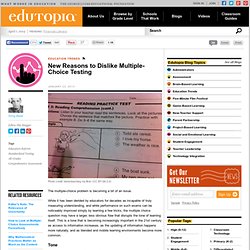
While it has been derided by educators for decades as incapable of truly measuring understanding, and while performance on such exams can be noticeably improved simply by learning a few tricks, the multiple choice question may have a larger, less obvious flaw that disrupts the tone of learning itself. This is a tone that is becoming increasingly important in the 21st century as access to information increases, as the updating of information happens more naturally, and as blended and mobile learning environments become more common. Tone. How to Destroy Education While Making a Trillion Dollars. The Vietnam War produced more than its share of iconic idiocies.
Perhaps the most revelatory was the psychotic assertion of an army major explaining the U.S. bombing of the provincial hamlet of Ben Tre: “We had to destroy the village in order to save it.” If only such self-extinguishing claims for intelligence were confined to military war. The U.S is ratcheting up a societal-level war on public education. At issue is whether we are going to make it better — build it into something estimable, a social asset that undergirds a noble and prosperous society — or whether we’re going to tear it down so that private investors can get their hands on the almost $1 trillion we spend on it every year. The Education Reform Dichotomy: Big Choices Ahead - Living in Dialogue. CriticalPedagogy - home.