
The White House Blog. Mark K.
Updegrove April 10, 2014 10:45 AM EDT Ed. note: Tune in to whitehouse.gov/live at 11:50 am ET to watch President Obama's remarks at the LBJ Presidential Library to commemorate the 50th anniversary of the signing of the Civil Rights Act. In early December 1972, heroes of the Civil Rights Movement of the 1950s and 1960s, braved a rare Austin ice storm to convene at the LBJ Presidential Library for a Civil Rights Symposium.
Towering figures like Hubert Humphrey, Barbara Jordan, Clarence Mitchell and Earl Warren rose to the stage in the course of the two-day conference to reflect on the movement they had helped to foster while examining the issues where progress was still needed. Among them was the host of the gathering, Lyndon Baines Johnson, the thirty-sixth President. Lyndon B. He considered the second—the Voting Rights Act—his greatest legislative achievement. Economist - World News, Politics, Economics, Business & Finance. Bill of Rights Transcript Text. On September 25, 1789, the First Congress of the United States proposed 12 amendments to the Constitution.
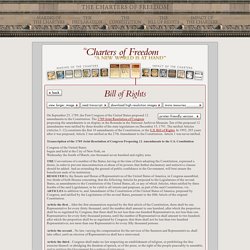
The 1789 Joint Resolution of Congress proposing the amendments is on display in the Rotunda in the National Archives Museum. Ten of the proposed 12 amendments were ratified by three-fourths of the state legislatures on December 15, 1791. The ratified Articles (Articles 3–12) constitute the first 10 amendments of the Constitution, or the U.S. Bill of Rights. In 1992, 203 years after it was proposed, Article 2 was ratified as the 27th Amendment to the Constitution. Transcription of the 1789 Joint Resolution of Congress Proposing 12 Amendments to the U.S. Congress of the United States begun and held at the City of New-York, on Wednesday the fourth of March, one thousand seven hundred and eighty nine.
Article the first... U.S. Constitution For Dummies Cheat Sheet. Cheat Sheet The U.S.

Constitution was written and signed by men who craved independence from Britain but who were nonetheless steeped in its history and ideals. The U.S. Constitution starts with some basic precepts of English governance, but then adds some uniquely American twists — three branches of government that act to check and balance each other, for example. Although much thought went into the Constitution, the Framers left it open to amendment.