
Learn Spanish, French, German, Portuguese, Italian and English for free. Esperanto grammar. For Esperanto morphology, see also Esperanto vocabulary Esperanto is a constructed auxiliary language.
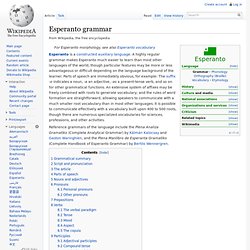
A highly regular grammar makes Esperanto much easier to learn than most other languages of the world, though particular features may be more or less advantageous or difficult depending on the language background of the learner. Parts of speech are immediately obvious, for example: Τhe suffix -o indicates a noun, -a an adjective, -as a present-tense verb, and so on for other grammatical functions.
An extensive system of affixes may be freely combined with roots to generate vocabulary; and the rules of word formation are straightforward, allowing speakers to communicate with a much smaller root vocabulary than in most other languages. Fundamento de Esperanto. Esperanto Participles. Participles are used to indicate the state in which something is.
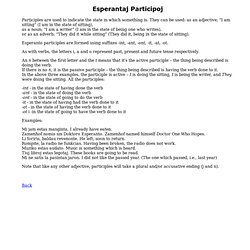
They can be used: as an adjective; “I am sitting” (I am in the state of sitting), as a noun; “I am a writer” (I am in the state of being one who writes), or as an adverb; “They did it while sitting” (They did it, being in the state of sitting). Esperanto participles are formed using suffixes -int, -ant, -ont, -it, -at, -ot. As with verbs, the letters i, a and o represent past, present and future tense respectively. An n between the first letter and the t means that it's the active participle – the thing being described is doing the verb. If there is no n, it is the passive participle – the thing being described is having the verb done to it. -int - in the state of having done the verb -ant - in the state of doing the verb -ont - in the state of going to do the verb -it - in the state of having had the verb done to it -at - in the state of having the verb done to it -ot i -in the state of going to have the verb done to it.
Esperanto Participle. The Esperanto Correlatives. Copyright Notice This material is copyright © 1995 by Donald J.
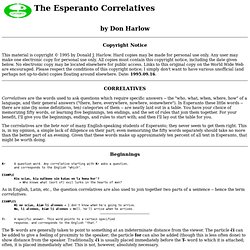
Harlow. Hard copies may be made for personal use only. Any user may make one electronic copy for personal use only. All copies must contain this copyright notice, including the date given below. Correlatives are the words used to ask questions which require specific answers -- the "who, what, when, where, how" of a language, and their general answers ("there, here, everywhere, nowhere, somewhere"). The correlatives are the bete noir of many English-speaking students of Esperanto; they never seem to get them right. Beginnings K- A question word. As in English, Latin, etc., the question correlatives are also used to join together two parts of a sentence -- hence the term correlatives. EXAMPLES Mi ne scias, kiam li alvenos = I don't know when he's going to arrive. T- A specific answer.
The T- words are generally taken to point to something at an indeterminate distance from the viewer. Esperanto Verb and Participle Forms. How To Talk Dirty In Esperanto : Kiel Paroli Maldece en Esperanto. Introduction : Enkonduko Be warned !
Personaj nomoj (given names) en Esperanto. What IS All This? The language this blog is written in is the constructed (as opposed to naturally evolved) “international language” of Esperanto.
Esperanto is a language that was designed to be “everyones second language”, and to function as a common communication medium between people of multiple cultures. The word “Usono” – the name of this blog – is the Esperanto translation of “United States Of North-America”. In Esperanto, America is considered to be both sets of continents, north and south, and there are other “united states” on those continents. So, the USA is given the distinction of being the one in North America.
I’m not going to present a history of the language here, as there are already so many treatments of the subject on the internet that do so much better than I could. How To Learn Esperanto? Welcome.
Here I describe the way I used to learn Esperanto. If you, for example, just got interested in Esperanto, or you have wanted to learn it for a long time, you can just follow this process and this should give you great results. Here is what I did and what you can do too: Esperanto Music on Internet. Facila Vento. Radio Verda - Programoj. Esperanto Radio Arkivo on PodcastAlley. Esperanta Retradio. Filmoj en Esperanto. Listen to free music online - free mp3 music downloads. If you thought you knew what World Music was all about, wait until you listen to this !
Since its creation over a century ago, Esperanto, the international language, has generated its own literature, poetry, drama, and of course, song lyrics adapted to a multitude of music trends from throughout the world. Styles range from medieval folklore all the way to experimental electronic manoeuvres. Every flavour of Rock, Pop and Folk Music as well as traditional European, Latin, Slavic and African rhythms, have successfully carried Dr Zamenhof's borderless language all around the globe. Far beyond a passing fad, this true commitment is an attempt to bring nations and generations together over an unselfish, inspired and legitimately universal concept.
Tajpi - Esperanto Keyboard. In the Esperanto alphabet there are six diacritical letters which cannot be typed using standard keyboard layouts.
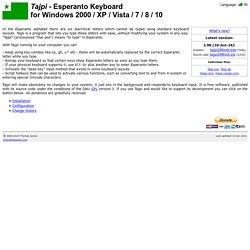
Tajpi is a program that lets you type these letters with ease, without modifying your system in any way. "Tajpi" (pronounced "thai pea") means "to type" in Esperanto. With Tajpi running on your computer you can: AbcTajpu. Free Online Language Translation. Vikipedio. El Vikipedio, la libera enciklopedio Interesaj faktoj el relative novaj artikoloj Faktoj el jam delonge ekzistantaj artikoloj Esperantisto estis urbestro de Madrido dum la hispana enlanda milito kaj estis mortpafita tuj post ties fino (vd. bildon).Unu el plej riĉaj ukrainaninoj ĝis meze de la 1990-aj jaroj havis nigran, rektan hararon kaj poste ŝanĝis ĝin al blonda hararplekto ne pro tio, ke ŝi estis en la serĉlisto de Interpol.Danke al okupado de sia lando gvidanto de la lokaj nazioj akiris novajn anojn por sia malsukcesinta partio kaj iĝis la unua homo deklarinta pri ŝtatrenverso per radio.La gvidanto de brazilaj ribeluloj estis kvaronumita postmorte kaj la ribelestro de rusaj vilaĝanoj estis tiel ekzekutita vivanta.La svisan kantonon kaj geologian eraon disdividas unu litero kaj milionoj da jaroj.
Free ebooks. Kurso de Esperanto. Lernu! - Learn Esperanto online. Infanoj Ĉirkaŭ la Mondo . . . Children Around the World . . . en Esperanto . . . Niños Alrededor del Mundo . . . . . . エスペラント入門講座.