
The Advantages of Technology in the Classroom. Technology is often intriguing to students, leading to a higher degree of student motivation.

When students tire of exploring standard written texts or composing essays on paper, teachers can regain their interest by providing them with technology-rich lessons that allow them to use technology to learn and produce creative and dynamic products, such as digital movies or multi-media presentations. Parenting.com: Technology in the Classroom: The Good and Bad. By Brian Braiker for Parenting Chris Crowell, a kindergarten teacher in Flemington, NJ, is summoned to the classroom kitchen area by Ava, 6, who has something to show him.

"Mr. Crowell, we have a spider in the sink," she says, matter-of-factly. "Why don't we check out the spider under the microscope? " he replies, perking up the rest of the students, who are enjoying free play at various stations around the room. Ava carries the removable tub from the sink to the "teacher table," where Pedro, 5, launches the Zoomy digital microscope, a small, egg-shaped device that connects via USB cable to the classroom laptop. After a few minutes of observing the spider's image magnified onto the classroom billboard, most of the students drift back to the areas where they had been playing prior to the sighting.
PLUS: The Right Technology for Kids at Every Age Crowell has been incorporating technology into his daily teaching since the floppy-disc era. Addiction vs. Anatomy of an App Dr. James Rosenberg: Technology in the Classroom: Friend or Foe? Effects of Technology on Classrooms and Students. A r c h i v e d I n f o r m a t i o n Change inStudent andTeacherRoles When students are using technology as a tool or a support for communicating with others, they are in an active role rather than the passive role of recipient of information transmitted by a teacher, textbook, or broadcast.
Technology in the Classroom. Educational Technology: Effectiveness of Computers in Education. Computers are increasingly being incorporated into school curriculums.
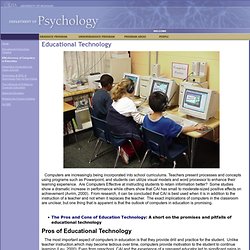
Teachers present processes and concepts using programs such as Powerpoint, and students can utilize visual models and word processor to enhance their learning experience. Are Computers Effective at instructing students to retain information better? Some studies show a dramatic increase in performance while others show that CAI has small to moderate-sized positive effects on achievement (Avrim, 2000). Benefits of technology. Pros and Cons of technology in education. Contributors: Rannah Dabiri, Noosha Deravi, Ahmed El Tamami, Erin Hong, Jack Percival, Kevin Torres, Max Weinberg, Katie Yeung, Brandon Zelner We were unable to partner with Habitat For Humanity for this month’s Service Learning.

Instead, we remained on campus, researching technology use in education and learning. This is an issue that has risen to prominence in conjunction with the widespread adoption of cell phones, smart phones, social media, and various other things associated with digital information and entertainment. After spending the morning researching and reading we summarized our findings, presenting them as short articles of pros and cons, found below. Researcher Studies Effects of Technology in Schools. SPRINGFIELD - A researcher at Missouri State University is launching a new study aimed at helping schools understand the pros and cons of technology in the classroom.

That includes the range of laptops, tablets and phones that students use these days. Technology programs are popping up in public schools across Missouri and the rest of the country. Some schools purchase devices for each student while others offer a program called "Bring Your Own Device" (BYOD), which allows students to bring their own devices to school.
Technology in the Schools: It Does Make a Difference! Brought to you by: TechnicalSchool.org This year, the Clinton administration earmarked an additional $25 million over last year's budget to help schools integrate technology into the curriculum and for technology training for teachers.

Will spending all that money really help kids learn? This week, Education World examines both sides of the Is technology worth it? Debate. Technology In Schools: Weighing The Pros And Cons. Research Center: Technology in Education. Technology in Schools Faces Questions on Value. The problem with technology in schools - The Root DC Live. Instant access to information has revolutionized how students learn today.
From an instructional perspective, education technology sounded great, but with its growing prevalence in America’s public schools, its true impact is gradually being revealed. And the news is not all good. A Pew Research Center survey found that nearly 90 percent of teachers believe that digital technologies were creating an (Norm Shafer - FOR THE WASHINGTON POST) easily distracted generation with short attention spans. About 60 percent said it hindered students’ ability to write and communicate face to face, and almost half said it hurt critical thinking and their ability to do homework. Between class periods, the halls of American high schools resemble a traffic jam on the interstate as they glare hypnotically into a screen.
Yet, this behavior does not always stop at the classroom door — and that has also become another major issue. Teachers reported that students are distracted constantly. Social and Cultural Foundations of American Education/Technology/Pros and Cons. What are the pros and cons of technology in the classroom?
Imagine it is your daughter’s first day of work after her high school graduation. She is working at a local company doing secretarial work to pay her way through college. Her new boss comes in and asks her to type the agenda for tomorrow’s meeting and email it to the staff by noon. When her boss walks away she just sits there wondering how she is going to complete this task in ample amount of time because she has no idea how to use the computer. Is it her fault that she did not learn how to use the computer? This is the reality of many high school graduates.