
Google search finds missing child. A nine-year-old girl, allegedly kidnapped by her grandmother, has been found using a mobile phone signal and Google Street View.

A police officer and a firefighter in Athol, Massachusetts, joined forces after authorities were alerted that Natalie Maltais had been taken. Officers used GPS in the girl's mobile phone to find her approximate location. They fed the co-ordinates into Google Street View, pinpointing a hotel where the child was subsequently found. The alarm was raised after grandmother Rose Maltais picked up Natalie from the child's legal guardians for what was supposed to be a weekend away. She "said that she wasn't going to return Natalie and then left the state", Athol police chief Timothy Anderson told the BBC. The police contacted Ms Maltais, but after she didn't return Natalie as promised, they decided to track them down using Natalie's mobile phone. This requirement has led to GPS capability in most new mobile phones in the US. Joined-up thinking. Top 10 industry-changing applications - Software - iTnews Austra. The Benefits of Distraction and Overstimulation. I.
The Poverty of Attention I’m going to pause here, right at the beginning of my riveting article about attention, and ask you to please get all of your precious 21st-century distractions out of your system now. Check the score of the Mets game; text your sister that pun you just thought of about her roommate’s new pet lizard (“iguana hold yr hand LOL get it like Beatles”); refresh your work e-mail, your home e-mail, your school e-mail; upload pictures of yourself reading this paragraph to your “me reading magazine articles” Flickr photostream; and alert the fellow citizens of whatever Twittertopia you happen to frequent that you will be suspending your digital presence for the next twenty minutes or so (I know that seems drastic: Tell them you’re having an appendectomy or something and are about to lose consciousness).
Good. Now: Count your breaths. Over the last several years, the problem of attention has migrated right into the center of our cultural attention. 5 Geeky Marriage Proposals That Worked. Propose to your girlfriend with technology and you’re bound to get blogged.

There’s no shame in that, though. If the idea of Cupid were conceived in modern times, he’d probably be sending messages through an RSS reader rather than shooting arrows with a bow, right? OK, probably not. TED: MIT Students Turn Internet Into a Sixth Human Sense. LONG BEACH, California — Students at the MIT Media Lab have developed a wearable computing system that turns any surface into an interactive display screen.
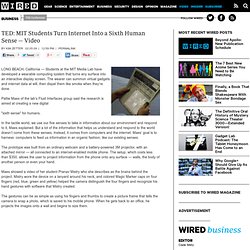
The wearer can summon virtual gadgets and internet data at will, then dispel them like smoke when they’re done. Pattie Maes of the lab’s Fluid Interfaces group said the research is aimed at creating a new digital "sixth sense" for humans. In the tactile world, we use our five senses to take in information about our environment and respond to it, Maes explained. But a lot of the information that helps us understand and respond to the world doesn’t come from these senses. Instead, it comes from computers and the internet. The prototype was built from an ordinary webcam and a battery-powered 3M projector, with an attached mirror — all connected to an internet-enabled mobile phone.
Foreign Policy: Net Effect: Neighborhood Watch. When a rush of violence broke out last January after Kenya's presidential election, many wondered why it was so unexpected. Electoral rigging set off the attacks, but surely tensions simmered before. Could Kenya have seen the outburst coming and perhaps done something to prevent it? Prediction, at least, was possible -- and Web-based nonprofit Ushahidi (Swahili for "testimony") did just that. Funded by grants and individual donations, Ushahidi had already developed software that allowed any mobile-phone user in Kenya to report incidents of community tension. Editor's Blog - The Winner of the Pred.
Google Chrome, Google's Browser Project. Google Chrome, Google’s Browser Project Today there was a comic book in my mail, sent by Google and drawn by no less than Scott McCloud, creator of the classic Understanding Comics.

Within the 38 pages, which I’ve scanned and put up, in very readable format Google gives the technical details into a project of theirs: an open source browser called Google Chrome. The book points to www.google.com/chrome, but I can’t see anything live there yet. In a nut-shell, here’s what the comic announces Google Chrome to be:Google Chrome is Google’s open source browser project. As rumored before under the name of “Google Browser”, this will be based on the existing rendering engine Webkit. Chrome has a privacy mode; Google says you can create an “incognito” window “and nothing that occurs in that window is ever logged on your computer.” This looks like a very interesting project, and I think it can’t hurt to have more competition in the browser area. [Images by Google.] >> More posts.