
DIY Video and Photography Projects. I’ll be attending CES – Las Vegas in a few weeks and am seriously considering doing most of the coverage on just the Sony HX9V. I’m not the only one obsessed with the little cameras ability to get decent video out, especially for just quick informational product interviews. (audio will be recorded separately). BBC cameraman and Vimeo member Johnnie Behiri even decided to try it out on a little segment with his BBC correspondent Bethany Bell (below). Definitely amazing quality for a camera that fits in your shirt pocket, and the Image Stabilization is the best i’ve used in a Point and Shoot. The only problem i’m thinking about is that on a two camera angle setup, the footage might not mix very well with another camera – So I thought i’d grab myself another one. There’s about 4 new ones left (not too bad a price).
I planned on just looking for a used one for a cheaper price, but ran into another option. 8 mm film. Super 8 mm, 8 mm and Standard (double) 8 mm formats.

Standard and Super 8 mm film comparison. "Super 8" 8 mm films 8 mm film is a motion picture film format in which the filmstrip is eight millimeters wide. It exists in two main versions — the original standard 8 mm film, also known as regular 8 mm or Double 8 mm, and Super 8. Although both standard 8 mm and Super 8 are 8 mm wide, Super 8 has a larger image area because of its smaller and more widely spaced perforations.
There are also two other varieties of Super 8—Single 8 mm and Straight-8 that require different cameras, but produce a final film with the same dimensions. Standard 8[edit] The standard 8 mm (also known as regular 8) film format was developed by the Eastman Kodak company during the Great Depression and released to the market in 1932 to create a home movie format that was less expensive than 16 mm. Common length film spools allowed filming of about 3 minutes to 4.5 minutes at 12, 15, 16 and 18 frames per second. The Camera Makers Pool. Frankencam research log. The Camera Hacks Pool. Film Specifications. Note, whenever possible, actual film frames are scanned and pictured above the specification list at precisely 180dpi to give an idea of scale.
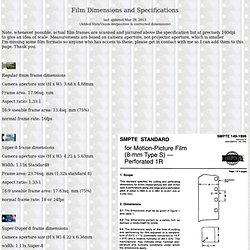
Measurements are based on camera aperture, not projector aperture, which is smaller. I'm missing some film formats so anyone who has access to these, please get in contact with me so I can add them to this page. Thank you. Regular 8mm frame dimensions Camera aperture size (H x W): 3.68 x 4.88mm Frame area: 17.96sq. mm Aspect ratio: 1.33:1 16:9 useable frame area: 13.4sq. mm (75%) normal frame rate: 16fps.
808 Car Keys Micro Camera, Micro Video Recorder, Review. DigitalRevCom. Tripod Heads: A Buyer’s Guide: Match To Your Shooting Needs. Just as interchangeable lenses on an SLR each have a specific purpose or meet a certain need, the same applies to tripod heads.

Even if a head comes as part of the tripod kit, you soon realize you may need to replace or supplement it. In this buyer’s guide to tripod heads we’ll look at some of the factors to consider, including budget, load considerations, applications, and matching heads to “sticks.” We’ll also look at the various types of heads available and how each can be used for very specific shooting needs. Acratech GP Lever Ballhead: This ball head will support 25 lbs and is compatible with Arca-type QR systems and others. Among its most salient features: lever-style quick release; head can also be used as gimbal head; can be mounted upside down and used as a leveling base for stitched panoramas.
Calumet Large Lens Gimbal Head (CK7075): This is a modestly-priced gimbal head. First off for some might be budget. These heads come in numerous flavors and sizes. Daiwa 11 K-Tek Norbert. Over a million full-size sample photos from SLR cameras with different lenses and digicams.