
Tests Show Most Store Honey Isn't Honey. More than three-fourths of the honey sold in U.S. grocery stores isn’t exactly what the bees produce, according to testing done exclusively for Food Safety News.
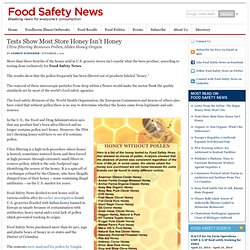
The results show that the pollen frequently has been filtered out of products labeled “honey.” The removal of these microscopic particles from deep within a flower would make the nectar flunk the quality standards set by most of the world’s food safety agencies. The food safety divisions of the World Health Organization, the European Commission and dozens of others also have ruled that without pollen there is no way to determine whether the honey came from legitimate and safe sources. In the U.S., the Food and Drug Administration says that any product that’s been ultra-filtered and no longer contains pollen isn’t honey. However, the FDA isn’t checking honey sold here to see if it contains pollen. Food Safety News purchased more than 60 jars, jugs and plastic bears of honey in 10 states and the District of Columbia. You’ll Never Know. The Lost Art of Buying From a Butcher. Joshua Bright for The New York Times Learn to talk to a butcher: you’ll eat well and save.

No, they cannot. And that is just one reason why Mr. Martins opened a real butcher shop on the Lower East Side last month. He’s not the only one. Buying some pork or most other meats is not as simple or as cheap as picking out an apple. “Here, you can have a conversation with a human being, and I can tell you that every transaction is different,” said Brent Young, one of the butchers at the Meat Hook in Williamsburg, Brooklyn.
How you plan to cook the meat determines the cut. “We can offer cuts you never see in a supermarket,” Mr. For those whose appetites stray beyond steak, a culinary adventure in the way of oxtails, marrow bones, kidneys, pig’s ears and trotters starts with the butcher, usually after a phone call in advance. It’s a major turnaround in the way meat has been bought and sold. This phenomenon is not limited to New York City. Are Apps Making Cookbooks Obsolete? Fast-forward two weeks, to the sweaty hours when the sticky notes have curled up and blown away, the cookbooks are taking up all the counter space, and the illustrations for cooking a turkey in “Joy of Cooking” are revealed to be no more informative than they were in 1951.

If the people developing cooking apps for tablets have their way, that kind of scene will soon be a relic. And so will the whole notion of recipes that exist only as strings of words. Many early cooking apps were unsatisfying: slow, limited, less than intuitive and confined to tiny phone screens. Even avid cooks showed little interest in actually cooking from them. But with the boom in tablet technology, recipes have begun to travel with their users from home to the office to the market and, most important, into the kitchen.
The interface of a tablet offers possibilities to the cook that would be impossible with a laptop, let alone a book. “I struggled with getting the whole recipe downloaded into my head,” he said.