
Aung San Suu Kyi. Suu Kyi received the Rafto Prize and the Sakharov Prize for Freedom of Thought in 1990 and the Nobel Peace Prize in 1991.
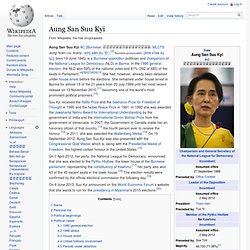
In 1992 she was awarded the Jawaharlal Nehru Award for International Understanding by the government of India and the International Simón Bolívar Prize from the government of Venezuela. In 2007, the Government of Canada made her an honorary citizen of that country,[13] the fourth person ever to receive the honour.[14] In 2011, she was awarded the Wallenberg Medal.[15] On 19 September 2012, Aung San Suu Kyi was also presented with the Congressional Gold Medal, which is, along with the Presidential Medal of Freedom, the highest civilian honour in the United States.[16] On 6 June 2013, Suu Kyi announced on the World Economic Forum’s website that she wants to run for the presidency in Myanmar's 2015 elections.[20] Name[edit] A family portrait, with Aung San Suu Kyi (in white) as a toddler, taken in 1947, shortly before her father's assassination.
Personal life[edit] Khin Kyi. Maha Thiri Thudhamma Khin Kyi (Burmese: ခင်ကြည်) was a Burmese politician and diplomat, best known for her marriage to the country's leader, Aung San, with whom she had a daughter, Aung San Suu Kyi.

She grew up in Myaungmya, an Irrawaddy delta town, the eighth of 10 brothers and sisters.[1] Khin Kyi attended the American Baptist Mission-run Kemmendine Girls School (now Basic Education High School No. 1 Kyimyindaing) in Rangoon, and continued her tertiary education at the Teachers' Training College (TTC) in Moulmein.[1] She then went on to become a teacher at the National School in her hometown, before deciding to give it up altogether to join the nursing profession against her mother's wishes, following the footsteps of her two elder sisters, who were at the time, training to become nurses.[1] Khin Kyi moved to Rangoon and joined the staff of the Rangoon General Hospital as a nursing probationer.[1] Khin Kyi and her three children in 1948. Family[edit] The wedding of Aung San and Khin Kyi.
Daw aung san suu kyi. 28 Days Later Font. Aung San. In this Burmese name, Bogyoke is an honorific.

Bogyoke (General) Aung San (Burmese: ဗိုလ်ချုပ် အောင်ဆန်း; MLCTS: buil hkyup rki aung hcan:, pronounced: [bòdʑoʊʔ àʊɴ sʰáɴ]); 13 February 1915 – 19 July 1947) was a Burmese revolutionary, nationalist, founder of the modern Burmese army (Tatmadaw), and considered to be the Father of modern-day Burma. He was responsible for bringing Burma's independence from British colonial rule in Burma, but was assassinated six months before independence.
He is recognized as the leading architect of independence, and the founder of the Union of Burma. Affectionately known as "Bogyoke" (General), Aung San is still widely admired by the Burmese people, and his name is still invoked in Burmese politics to this day. Aung San had a daughter, Aung San Suu Kyi, who is a Burmese politician and the recipient of a Nobel Peace Prize. Youth[edit] Names of Aung San[edit] Struggle for independence[edit] Portrait of the 1936 Oway magazine's editorial committee Family[edit] Myanmar_map.jpg (JPEG Image, 400×614 pixels) 2.bp.blogspot.com/-6vXeW-doHQs/TtZrumVXjMI/AAAAAAAAB-Q/AlW8sFX_o1A/s1600/Shepard-Fairey-Aung-San-Suu-Kyi_thumb.