
101 New Uses for Everyday Things. 28 Uses for Everyday Items. CDC Study Finds Rocket Fuel Chemical in Baby Formula. Perchlorate, a hazardous chemical in rocket fuel, has been found at potentially dangerous levels in powdered infant formula, according to a study (pdf) by a group of U.S.
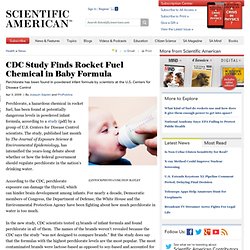
Centers for Disease Control scientists. The study, published last month by The Journal of Exposure Science & Environmental Epidemiology, has intensified the years-long debate about whether or how the federal government should regulate perchlorate in the nation’s drinking water. According to the CDC, perchlorate exposure can damage the thyroid, which can hinder brain development among infants. For nearly a decade, Democratic members of Congress, the Department of Defense, the White House and the Environmental Protection Agency have been fighting about how much perchlorate in water is too much. In the new study, CDC scientists tested 15 brands of infant formula and found perchlorate in all of them. In a statement sent to reporters last night, Sen. Dangers of watering down baby formula - Staying Healthy Story. -Dr.Dianne McCallister, Chief Medical Officer at Porter Adventist Hospital As we move into Thanksgiving, we are again reminded of those for who are having trouble getting enough to eat for their families - a problem called "food insecurity".

In fact, 16-22 percent of American families find themselves coming up short on funds at the end of the month. An article earlier this year in the Journal Pediatrics looked at the food in a clinic in Cincinnati. They found a third of families in the clinic had food insecurity - and among these families, up to an eighth were unknowingly endangering their infants by watering down the formula trying to stretch their budgets. Before we discuss formulas, it is important to remind all new mothers that the best choice for their infants is breast milk.
While some formulas are based on cows milk - children under one year of age should NOT be fed cows milk - it does not have the correct nutrients, and it can cause irritation of the lining of the stomach. Dr. Too Much Calcium For Children. The mineral, calcium, comes from many dietary sources.

Dairy products, orange juice, spinach and broccoli are a few examples of foods rich in calcium. Calcium also comes in the form of supplements and antacids. Adding vitamin D to the diet increases the body's ability to absorb calcium. The most common problem with calcium has to do with insufficient amounts. In rare cases, the body absorbs too much calcium and produces side effects.
Calcium maintains healthy teeth and bones. While a proper diet would supply all of the nutrients needed, the reality of regulated eating does not take into consideration the skipped meals or fast food meals that result from busy schedules. The possibility of taking in too much calcium from food happens occasionally. Too much calcium in the body would manifest in severe fatigue, depression, nausea, vomiting and diarrhea.
The pea-shaped parathyroid glands, sit in front of the thyroid gland. After 121 years, identification of 'grave robber' fossil solves a paleontological enigma. Public release date: 19-Nov-2012 [ Print | E-mail Share ] [ Close Window ] Contact: Leigh KishKishL@carnegiemnh.org 412-622-3361Carnegie Museum of Natural History Pittsburgh, PA…An international team of researchers, including Carnegie Museum of Natural History scientist John Wible, has resolved the evolutionary relationships of Necrolestes patagonensis, whose name translates into “grave robber,” referring to its burrowing and underground lifestyle.

This much-debated fossil mammal from South America has been a paleontological riddle for more than 100 years. Scientific perseverance, a recent fossil discovery, and comparative anatomical analysis helped researchers to correctly place the strange 16-million-year-old Necrolestes, with its upturned snout and large limbs for digging, in the mammal evolutionary tree. The scientific paper resolving the mystery of Necrolestes appears today in Proceedings of the National Academy of Sciences USA. A paleontological riddle Confusing anatomy Future research.