
The Lazy Rule of Thirds. I can count on one hand the number of rules I will obey without question, based solely on fear of catastrophic consequences: I turn off personal electronics during landing and take-off, I keep my hands inside the ride at all times, I don’t rock vending machines, I resist the urge to climb over zoo fences and I no longer lunge for a police officer’s holstered gun on April Fools Day.
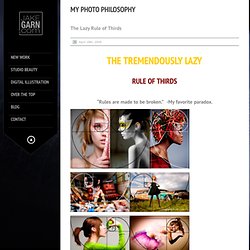
Pretty much everything else is up for debate. That brings me to the Rule of Thirds. After a tremendous amount of research (I read a book) I learned that the rule of thirds may actually be just a lazy man’s sham. That’s right, I said it… a lazy sham! On the surface the rule of thirds doesn’t really make a ton of sense, I mean why would a composition broken up into three equal parts be innately more appealing than any other random spattering in a composition? How to apply Golden Ratio in Graphic Design, Golden rectangule. Making a grid is the basis for any great design, this week we will study the golden ratio; its history and how to apply in graphic design.

What is the Golden Ratio [tweetmeme]At least since the Renaissance, many artists and architects have proportioned their works to approximate the golden ratio, especially in the form of the golden rectangle, in which the ratio of the longer side to the shorter is the golden ratio, believing this proportion to be aesthetically pleasing. Mathematicians have studied the golden ratio because of its unique and interesting properties. In mathematics and the arts, two quantities are in the golden ratio if the ratio of the sum of the quantities to the larger quantity is equal to (=) the ratio of the larger quantity to the smaller one. The golden ratio is an irrational mathematical constant, approximately: Construction of the Golden Rectangle History The golden ratio has fascinated Western intellectuals of diverse interests for at least 2,400 years. Logos Resources. The Secret Law of Page Harmony. “A method to produce the perfect book.”
The perfect book. This is how designer-genius Jan Tschichold described this system. Not the ok book, nor the pretty good book, but the perfect book. This method existed long before the computer, the printing press and even a defined measuring unit. No picas or points, no inches or millimeters. And you can still use it. The Secret Canon & Page Harmony Books were once a luxury only the richest could afford and would take months of work to be brought to fruition.
And they were harmoniously beautiful. The bookmakers knew the secret to the perfect book. So elegant is this method of producing harmony that a few designers saw to rediscover it. They found the way to design a harmonious page. There’s a dance to all this Let’s look at this dance, shall we? And here it is with them (using the Van de Graaf Canon and Tschichold’s recommended 2:3 page-size ratio, which we’ll get into next).
This is where the harmony is found. How is this dance beautiful? The J. Well.