
Trees: Species: Crabapple. There are few plants that create greater intrigue or visual impact during all four seasons than the flowering crabapple.

In the spring all eyes are enticed with delicate colors offered by emerging leaves and buds. Unopened flower buds may hint of one color and as flowers open, other hues are revealed in a spectacular floral display. As flowers fade the rich foliage offers another subtle contribution to the landscape. As autumn arrives crabapple foliage and fruit transform to match the vibrant colors of an artist's palette. Falling leaves reveal the glorious color of the fruit. Depending on the cultivar and spring temperatures, full bloom could occur as early as late April or delay until mid-May. Blossom colors range from pearly white through delicate pinks to a deep red. Apples and crabapples are in the rose family, Rosaceae, in the genus Malus. Fruit is borne in the summer and fall. Crabapples have diverse growth habits or tree shapes. Detailed information on Red Jewel Crabapple Malus 'Red Jewel'
Garden Care : Arborvitaes. Arborvitaes Arborvitae is one of the most versatile, easy-to-grow evergreens suited to cold northern landscapes, used as specimen plants, hedges, foundation plantings and windbreaks.

Arborvitaes are highly adaptable plants. Not only can they be used in many ways, but another great asset is that arborvitaes grow quickly, making them a relatively affordable evergreen. Hetz Midget Arborvitae (Thuja occidentalis 'Hetz Midget') - Monrovia - Hetz Midget Arborvitae (Thuja occidentalis 'Hetz Midget') Growth habit:Round Growth rate:Slow.

Pruning Lilacs. Deadheading, also part of annual maintenance, should be done as soon as possible after the flowers fade.
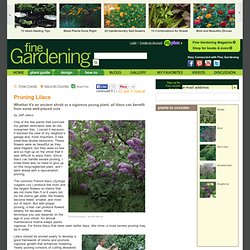
The old flower cluster should be cut off at its base—just above the two new shoots that angle out from the stem that ended with the old flower. The new shoots will grow over the summer, set flower buds, and be topped off with a flower cluster the following spring. While not as important as the yearly thinning, removing the old blossoms allows more of the plant’s energy to be directed into growing vigorous shoots and flower buds. I do both my deadheading and yearly thinning in June. While doing this yearly maintenance, I sometimes come across a candidate for tipping off: a young, vigorous shoot that might be getting too tall but is still a good, productive stem. Pruning Lilacs - How and When to Prune Lilacs. Anyone who has old lilacs growing on their property knows that lilac plants put out enough suckers to keep themselves alive for centuries.

To keep your lilac thriving and blooming, some periodic pruning is advised. Why Prune Lilacs? If lilacs are left to grow and spread on their own, without maintenance pruning, you will get shrubs reaching 15 - 20' in height and all the blooms will be way above your head. Lilac plants that have a balance of new shoots and older stems, will bloom best. The newer stems won't bloom for a couple of years, but to keep the flowers coming steadily, you need to constantly renew the plants. How to Prune Lilacs, Pruning Lilacs. For the absolutely perfectly shaped lilac bush, you need to prune them each year.

Pruning lilacs is a very important part of growing and caring for Lilacs. While some varieties only grow 4 to 8 feet, others can reach up to 30 feet tall. Pruning Large, Overgrown Lilacs. This article was published originally on 2/10/1993 Byline: by Richard Jauron, Department of Horticulture The common purple lilac is a tough, reliable shrub that may reach a height of 15 to 20 feet.

Unfortunately, as lilacs mature, the shaded lower portions of the shrubs usually lose their leaves. Peonies for the Home Landscape. Bronze Beauty Carpet Bugle (Ajuga reptans 'Bronze Beauty') - Monrovia - Bronze Beauty Carpet Bugle (Ajuga reptans 'Bronze Beauty') Botanical Pronunciation:a-JU-gah REP-tanz Sunset climate zones:1 - 24, 29 - 45 Growth habit:Spreading Growth rate:Slow Average landscape size:Reaches 2 to 5 in. tall, 12 to 18 in. wide.

Blooms:Summer Design IdeasOutstanding groundcover for shaded high profile locations where plants are viewed up close. Ajuga reptans Burgundy Glow. Culture Ajuga reptans is easy to grow and easy to transplant.

It prefers a well-drained shady location but also performs well in sunny areas. Soil should contain organic matter. A light, early spring fertilization is sufficient. Spreads rapidly. Noteworthy Characteristics Ajuga reptans is noted for the striking range of foliage colors and textures. Problems. Ajuga Ground Cover. Plant Taxonomy of Bugleweed: Taxonomy classifies bugleweed (sometimes misspelled "bugle weed") or "bugle" as Ajuga reptans.

Ground Covers: Ajuga reptans. Sedum ‘Autumn Joy’ (Stonecrop. Posted by BombasticTurtle11/14/2011 Region: Mountain West Zone: 3 I live in Edmonton, Alberta; where we have very short summers! I planted the Autumn Joy Sedum in the May of 2005 and it has never failed me as a beginner in the garden, Grows nice and dense, the succulent leaves are full, well spread (upto three feet wide and as high), grow right down to the ground so you don't need any facer plants, full bodied right from spring to late fall, the blood red fall flowers are impressive and more so when they and everything else around it are covered in snow, pest and insect resistant, can tolerate standing water or drought periods and needs very little to no care. How to Transplant Sedum. Peony Care. Sambucus nigra Eva BLACK LACE. Culture Grow in medium to wet, well-drained soils in full sun to light shade.
Best foliage color is in full sun. Tolerates a wide range of soils, but prefers moist, humusy ones. Spreads by root suckers to form colonies. Prune suckers as they appear unless naturalizing. Noteworthy Characteristics BLACK LACE is a cultivar of European elderberry. Problems.