
Justin Elliott
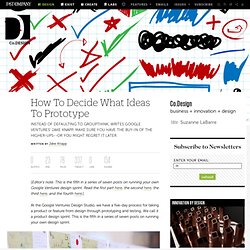
How To Decide What Ideas To Prototype. [Editor’s note: This is the fifth in a series of seven posts on running your own Google Ventures design sprint.
Read the first part here, the second here, the third here, and the fourth here.] At the Google Ventures Design Studio, we have a five-day process for taking a product or feature from design through prototyping and testing. We call it a product design sprint. This is the fifth in a series of seven posts on running your own design sprint. At this point in a design sprint, you’ve got a lot of ideas down on paper. It’s awesome to have a lot of ideas. Today we’ll look at how to decide which solutions to flesh out, and how you’ll fit them together into something you can rapidly test with users to learn what’s working and what isn’t. Combat the group effect The decision-making process is hard, and this is one place where working as a group can become a liability.
To combat this effect, the facilitator often has to draw out the decision-maker to give their honest, true opinion. Related. The 8 Steps To Creating A Great Storyboard. [Editor’s note: This is the fourth in a series of seven posts on running your own Google Ventures design sprint.
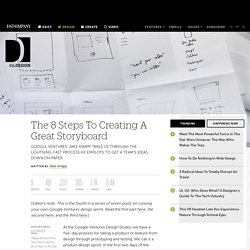
Read the first part here, the second here, and the third here.] At the Google Ventures Design Studio, we have a five-day process for taking a product or feature from design through prototyping and testing. We call it a product design sprint. In the first two days of the sprint, we’ve learned about the problem, shared a lot of knowledge, and chosen the challenge we want to tackle in this sprint. It’s time to start cranking out solutions. I call this step "diverge" because when everyone (from the CEO to the marketing manager) is cranking out quick sketches, we tend to get a lot of ideas—and different kinds of ideas. Although you’re going to be generating ideas, don’t think of this as brainstorming—at least not the everybody-is-shouting kind of brainstorming.
Dust off those old ideas Paper first 1. In Day 1, you drew a user story diagram. Now decide which part to focus on first. The First Step In A Design Challenge: Build Team Understanding. [Editor’s note: This is the third post in a seven-part series from Google Ventures Design Studio on how to conduct your own design sprint.

Read the first post here; the second here.] Now that you know when to get your team together for a sprint and how to set one up, it’s time to tackle the first day of the sprint: understanding. Chances are that everyone involved in the sprint has different perspectives on the problem--and different information that might be helpful. The goal of the first day is to encourage everyone to share what they already know and develop a common understanding with the rest of the group. By starting at the beginning (even if some people are already familiar with the problem), it nudges the group into a beginner’s mindset and leads to fresh solutions.
Use these exercises to help build understanding. How to choose the right UX metrics for your product. When designing for the web, you can analyze usage data for your product and compare different interfaces in A/B tests.
This is sometimes called “data-driven design”, but I prefer to think of it as data-informed design — the designer is still driving, not the data. To make this work in practice it’s important to use the right metrics. Basic traffic metrics (like overall page views or number of unique users) are easy to track and give a good baseline on how your site is doing, but they are often not very useful for evaluating the impact of UX changes. This is because they are very general, and usually don’t relate directly to either the quality of the user experience or the goals of your project — it’s hard to make them actionable. I’m part of a group of quantitative UX researchers at Google, and we like to think of large-scale data analysis as just another UX research method.
This Woman Wants To Be Your Networking Wingman. For $28 you can take Christine Hauer for a walk in the park.

For $165 you can bring her to a party and introduce her as your "assistant" or "friend" or "colleague"--"whatever you feel most comfortable with. " She isn’t offering what your dirty mind is imagining, though. She’s "confidence building" in the park and being a "networking sidekick" at the party. They’re micro-services that are usually small parts of the larger job of doing public relations, but now, thanks to the Internet, can be purchased as discrete components. Over the phone, I asked Hauer exactly what I would get from a "networking sidekick. " Hauer sells that genuine excitement on one of the first wave of “storefronts” at online marketplace Zaarly. In Hauer’s case, those services are an outgrowth of an existing business: the Hi Five Agency, where she does an array of PR activities for clients like Jet’s defensive tackle Kenrick Ellis and celebrity hair and make-up artist John O.
Architecture Magazine. Death by Architecture. Exhibition: Open the Tower.
* peeps. * research. * creations. * STUDIO Architecture. * architecture firms. * design. * music.