
Herodotus. Place in history[edit]
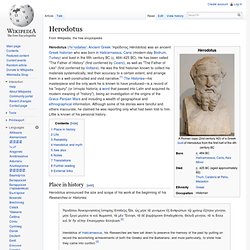
Cleopatra. Cleopatra VII Philopator (Greek: Κλεοπάτρα Φιλοπάτωρ; Late 69 BC[1] – August 12, 30 BC), known to history as Cleopatra, was the last active pharaoh of Ancient Egypt, only shortly survived by her son, Caesarion as pharaoh.
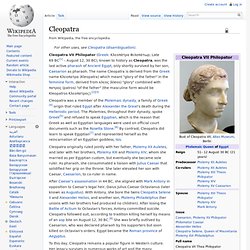
The name Cleopatra is derived from the Greek name Κλεοπατρα (Kleopatra) which meant "glory of the father" in the feminine form, derived from κλεος (kleos) "glory" combined with πατρος (patros) "of the father" (the masculine form would be Kleopatros Κλεοπατρος).[2][3] Cleopatra was a member of the Ptolemaic dynasty, a family of Greek [4] origin that ruled Egypt after Alexander the Great's death during the Hellenistic period.
Isaac Newton. Sir Isaac Newton PRS MP (/ˈnjuːtən/;[8] 25 December 1642 – 20 March 1726/7[1]) was an English physicist and mathematician (described in his own day as a "natural philosopher") who is widely recognised as one of the most influential scientists of all time and as a key figure in the scientific revolution.
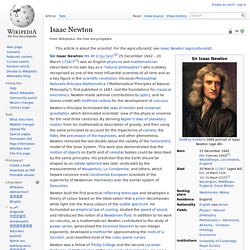
His book Philosophiæ Naturalis Principia Mathematica ("Mathematical Principles of Natural Philosophy"), first published in 1687, laid the foundations for classical mechanics. Heraclitus. Heraclitus of Ephesus (/ˌhɛrəˈklaɪtəs/;[1] Greek: Ἡράκλειτος ὁ Ἐφέσιος, Hērákleitos ho Ephésios; c. 535 – c. 475 BCE) was a pre-Socratic Greek philosopher, a native of the Greek city Ephesus, Ionia, on the coast of Asia Minor.
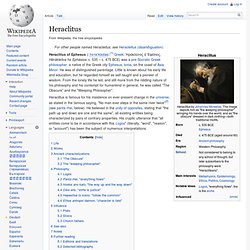
He was of distinguished parentage. Little is known about his early life and education, but he regarded himself as self-taught and a pioneer of wisdom. Socrates. Socrates (/ˈsɒkrətiːz/;[2] Greek: Σωκράτης [sɔːkrátɛːs], Sōkrátēs; 470/469 – 399 BC)[1] was a classical Greek (Athenian) philosopher credited as one of the founders of Western philosophy.
He is an enigmatic figure known chiefly through the accounts of classical writers, especially the writings of his students Plato and Xenophon and the plays of his contemporary Aristophanes. Plato's dialogues are among the most comprehensive accounts of Socrates to survive from antiquity, though it is unclear the degree to which Socrates himself is "hidden behind his 'best disciple', Plato".[3] Epicurus. Ancient Greek philosopher For Epicurus, the purpose of philosophy was to help people attain a happy, tranquil life characterized by ataraxia (peace and freedom from fear) and aponia (the absence of pain).
He advocated that people were best able to pursue philosophy by living a self-sufficient life surrounded by friends. He taught that the root of all human neurosis is death denial and the tendency for human beings to assume that death will be horrific and painful, which he claimed causes unnecessary anxiety, selfish self-protective behaviors, and hypocrisy. According to Epicurus, death is the end of both the body and the soul and therefore should not be feared. Epicurus taught that although the gods exist, they have no involvement in human affairs. Nicolaus Copernicus. 15th–16th-century mathematician and astronomer.
Nikola Tesla. Nikola Tesla (Serbian Cyrillic: Никола Тесла; 10 July 1856 – 7 January 1943) was a Serbian-American[3][4] inventor, electrical engineer, mechanical engineer, physicist, and futurist who is best known for his contributions to the design of the modern alternating current (AC) electricity supply system.[5] Born and raised in the Austrian Empire, Tesla received an advanced education in engineering and physics in the 1870s and gained practical experience in the early 1880s working in telephony and at Continental Edison in the new electric power industry.
He emigrated to the United States in 1884, where he would become a naturalized citizen. He worked for a short time at the Edison Machine Works in New York City before he struck out on his own. With the help of partners to finance and market his ideas, Tesla set up laboratories and companies in New York to develop a range of electrical and mechanical devices. Early years Tesla's baptismal record, 28 June 1856 Working at Edison A move to the US. Bill Gates. Benjamin Franklin. Benjamin Franklin FRS (January 17, 1706 [O.S.
Leonardo da Vinci. Leonardo is revered for his technological ingenuity.
He conceptualised flying machines, an armoured vehicle, concentrated solar power, an adding machine,[7] and the double hull, also outlining a rudimentary theory of plate tectonics. Relatively few of his designs were constructed or were even feasible during his lifetime,[nb 2] but some of his smaller inventions, such as an automated bobbin winder and a machine for testing the tensile strength of wire, entered the world of manufacturing unheralded. [nb 3] He made substantial discoveries in anatomy, civil engineering, optics, and hydrodynamics, but he did not publish his findings and they had no direct influence on later science.[8] Life. Archimedes. Archimedes of Syracuse (Greek: Ἀρχιμήδης; c. 287 BC – c. 212 BC) was a Greek mathematician, physicist, engineer, inventor, and astronomer.[1] Although few details of his life are known, he is regarded as one of the leading scientists in classical antiquity.
Among his advances in physics are the foundations of hydrostatics, statics and an explanation of the principle of the lever. He is credited with designing innovative machines, including siege engines and the screw pump that bears his name. Modern experiments have tested claims that Archimedes designed machines capable of lifting attacking ships out of the water and setting ships on fire using an array of mirrors.[2] Aristotle. Aristotle's views on physical science profoundly shaped medieval scholarship. Their influence extended into the Renaissance and were not replaced systematically until the Enlightenment and theories such as classical mechanics. Some of Aristotle's zoological observations, such as on the hectocotyl (reproductive) arm of the octopus, were not confirmed or refuted until the 19th century. His works contain the earliest known formal study of logic, which was incorporated in the late 19th century into modern formal logic.
Plato. Plato (/ˈpleɪtoʊ/; Greek: Πλάτων Plátōn "broad"pronounced [plá.tɔːn] in Classical Attic; 428/427 or 424/423 – 348/347 BCE) was a philosopher, as well as mathematician, in Classical Greece. Leucippus. Leucippus or Leukippos ( Greek: Λεύκιππος , first half of 5th century BCE ) was one of the earliest Greeks to develop the theory of atomism — the idea that everything is composed entirely of various imperishable, indivisible elements called atoms — which was elaborated in greater detail by his pupil and successor, Democritus .
According to this atomism, if you take a piece of wood and then cut it into two equal parts, then do it continuously, eventually you will find a part that you can't cut. This smallest possible part is the "atom". A possible earlier candidate for atomism is Mochus of Sidon , from the Trojan War era (13th or 12th century BCE). [ 1 ] [ 2 ] [ 3 ] Pythagoras. Pythagoras of Samos (/pɪˈθæɡərəs/; Ancient Greek: Πυθαγόρας ὁ Σάμιος Pythagóras ho Sámios “Pythagoras the Samian”, or simply Πυθαγόρας; Πυθαγόρης in Ionian Greek; c. 570 BC – c. 495 BC)[1][2] was an Ionian Greek philosopher, mathematician, and founder of the religious movement called Pythagoreanism.
Most of the information about Pythagoras was written down centuries after he lived, so very little reliable information is known about him.