
Codex Alexandrinus. It derives its name from Alexandria where it resided for a number of years before it was brought by the Eastern Orthodox Patriarch Cyril Lucaris from Alexandria to Constantinople.[5] Then it was given to Charles I of England in the 17th century.
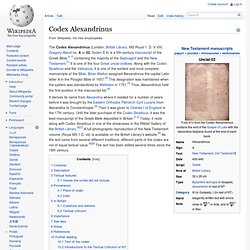
Until the later purchase of the Codex Sinaiticus, it was the best manuscript of the Greek Bible deposited in Britain. [n 2] Today, it rests along with Codex Sinaiticus in one of the showcases in the Ritblat Gallery of the British Library.[6][7] A full photographic reproduction of the New Testament volume (Royal MS 1 D. viii) is available on the British Library's website.[8] As the text came from several different traditions, different parts of the codex are not of equal textual value.[6][9] The text has been edited several times since the 18th century. Contents[edit] Colophon at the end Epistle of Jude. According to this colophon Acts of the Apostles follows General epistles. What is Authentic Assessment? What is Authentic Assessment?
Definitions What Does Authentic Assessment Look Like? How is Authentic Assessment Similar to/Different from Traditional Assessment? Alternative Names for Authentic Assessment A form of assessment in which students are asked to perform real-world tasks that demonstrate meaningful application of essential knowledge and skills -- Jon Mueller "...Engaging and worthy problems or questions of importance, in which students must use knowledge to fashion performances effectively and creatively.
The tasks are either replicas of or analogous to the kinds of problems faced by adult citizens and consumers or professionals in the field. " -- Grant Wiggins -- (Wiggins, 1993, p. 229). Electronic Journals for Religion.