
Carbon emissions 'hidden' in imported goods revealed. 25 April 2011Last updated at 20:04 By Roger Harrabin Environment analyst, BBC News Emissions data from major exporters like China can be unclear The extent of carbon dioxide (CO2) emissions "hidden" in imported goods is growing, according to two studies.

Official data do not include emissions from making imported goods but both sets of researchers say they should. The Proceedings of the National Academy of Sciences reports 26% of global emissions come from producing goods for trade. The Carbon Trust found such "embedded" CO2 could negate domestic carbon cuts planned in the UK up to 2025. 'Delusion' Researchers want all nations to publish their data on embedded emissions. Glen Peters of research group Cicero, lead authors of the PNAS report, told BBC News: "There is a degree of delusion about emissions cuts in developed nations.
Continue reading the main story “Start Quote Publishing this sort of data is the first step, the next step - what to do about it - is more difficult” Border taxes. Overview of Greenhouse Gas Control Policies in Various Countries. As Congress considers legislation to address climate change, and follows negotiations toward a new international agreement to reduce greenhouse gas (GHG) emissions, the question of the comparability of actions across countries frequently arises.
Concerns are raised about what the appropriate sharing of efforts should be among countries, as well as the potential trade implications if countries undertake different levels of GHG reductions and, therefore, incur varying cost impacts on trade-sensitive sectors. This report summarizes the GHG control policies in effect or under consideration in the European Union (EU) and various other large countries, and offers a brief set of initial observations. It gives particular emphasis to how particular tradesensitive sectors may be treated in the context of each national program. All countries examined have in place, or are developing, some enforceable policies that serve to reduce GHG emissions. Introduction Synthesis Observations European Union 2. Greenhouse Gas Equivalencies Calculator. <p class="warning">This calculator requires JavaScript, which is currently disabled in your browser.
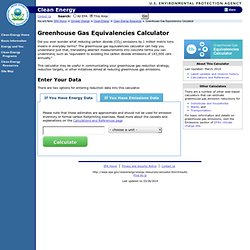
To calculate the equivalencies manually, you can refer to <a href="refs.html"> the calculations and assumptions page</a>. </p> Did you ever wonder what reducing carbon dioxide (CO2) emissions by 1 million metric tons means in everyday terms? The greenhouse gas equivalencies calculator can help you understand just that, translating abstract measurements into concrete terms you can understand, such as "equivalent to avoiding the carbon dioxide emissions of 183,000 cars annually. " This calculator may be useful in communicating your greenhouse gas reduction strategy, reduction targets, or other initiatives aimed at reducing greenhouse gas emissions.
There are two options for entering reduction data into this calculator. Please note that these estimates are approximate and should not be used for emission inventory or formal carbon footprinting exercises. CAIT - Login. GHG data from other sources. Description FAO, as part of its mandate, compiles information and data on various aspects of food and agriculture from all countries in FAOSTAT.

The user interface to the database provides data under 18 domains. The data can be classified into three groups: country-level data referring to items such as agricultural production and trade, producer prices, land use, and means of production; derived data such as agricultural production and trade indices and food supply; and data referring to items such as population and labour force that are derived by, or in collaboration with, other international agencies. FAOSTAT includes data on production, trade, food balance sheets, fertilizer and pesticides, land use and irrigation, forest products, fishery products, population, agricultural machinery and food aid shipments. Data sources. Environmental Information.