
Newsroom. t552site. BBC Systems Practice - Managing Complexity. Copyrighted image Credit: The Open University Open2.net fades away...

For ten years, give or take, Open2.net was the online home of Open University and BBC programming. Over the last few months, though, we've been moving into OpenLearn, creating one home for all The Open University's free learning content. It means we share a home with the Open University's iTunesU and YouTube channels, and much more besides. You can use the navigation at the top of this page to explore what we have on offer. There's lots to do - you could watch Evan Davis exploring the state of British manufacturing7; explore the frozen planet8; get to know the science and history of the Olympics9 or have a look at our free courses. Systems thinking. Impression of systems thinking about society[1] A system is composed of interrelated parts or components (structures) that cooperate in processes (behavior).
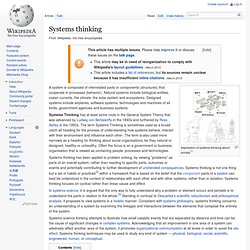
Natural systems include biological entities, ocean currents, the climate, the solar system and ecosystems. Designed systems include airplanes, software systems, technologies and machines of all kinds, government agencies and business systems. Systems Thinking has at least some roots in the General System Theory that was advanced by Ludwig von Bertalanffy in the 1940s and furthered by Ross Ashby in the 1950s. The term Systems Thinking is sometimes used as a broad catch-all heading for the process of understanding how systems behave, interact with their environment and influence each other.