
The 'Art' of failure. Everyone has the odd bad print or failure that results in something interesting or frustrating depending on how urgently you needed the part to print.
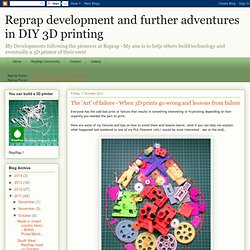
Here are some of my failures and tips on how to avoid them and lessons learnt. (And if you can help me explain what happened last weekend to one of my PLA filament rolls I would be most interested - see at the end). It may sound odd, but it's really essential that you fail when doing 3D printing, It tells you so much about your machine, the boundaries you can operate in and how good or bad things can be. If all you do is print with safe settings or never play with the electronics or firmware the you are missing so much of this wonderful project. You also can't just be told what settings to use and how fast to run etc. you need to feel how your particular machine works and what it's capable of.
Below are a few of my print failures during the summer, and some reasons for the failure where I know what happened. Temperature - Hot-end Jamming - A Creative Outlet for Artists. Despite the chicken-in-every-pot hype over consumer-level 3-D printers, the technology still has a long way to go to be usable, or useful, for the average Joe.

Designing three-dimensional objects on a two-dimensional computer screen is no simple task, especially for those unskilled in computer-assisted design or software. And for most people, there's no compelling reason to make a unique object from scratch when mass-produced equivalents are cheaper and simpler. But for some artists, 3-D printing has been a revelation. The ability to design and build objects layer by layer, rather than through traditional methods such as casting or handcrafting, has created a new level of freedom. So while 3-D printing has yet to live up to its promise for consumers, for artists, the technology has been fueling a design explosion for more than a decade.
Bathsheba Grossman is amused by the recent flood of attention. PHOTOS: Arts and culture in pictures by The Times. 3D Printing Basics. Table of contents: 1.
What is 3D printing? 3D printing is also known as desktop fabrication or additive manufacturing. It is a prototyping process whereby a real object is created from a 3D design. The digital 3D-model is saved in STL format and then sent to a 3D printer. 2. 3D printing technologies There are several different 3D printing technologies. SLS (selective laser sintering), FDM (fused deposition modeling) & SLA (stereolithograhpy) are the most widely used technologies for 3D printing.
This video describes how laser-sintering processes melt fine powders, bit by bit, into 3D shapes. This video shows how FDM works. The video below explains the process of Stereolithography (SLA). Generally, the main considerations are speed, cost of the printed prototype, cost of the 3D printer, choice and cost of materials and color capabilities. 3. October 5, 2011 - Roland DG Corporation introduced the new iModela iM-01.
This smallest 3D printer weighs 1.5 kilograms, it costs around 1200 Euros. 5. 6. 3D printing. An ORDbot Quantum 3D printer. 3D printing or additive manufacturing[1] is a process of making a three-dimensional solid object of virtually any shape from a digital model. 3D printing is achieved using an additive process, where successive layers of material are laid down in different shapes.[2] 3D printing is also considered distinct from traditional machining techniques, which mostly rely on the removal of material by methods such as cutting or drilling (subtractive processes).
A 3D printer is a limited type of industrial robot that is capable of carrying out an additive process under computer control. The 3D printing technology is used for both prototyping and distributed manufacturing with applications in architecture, construction (AEC), industrial design, automotive, aerospace, military, engineering, dental and medical industries, biotech (human tissue replacement), fashion, footwear, jewelry, eyewear, education, geographic information systems, food, and many other fields.