
Everyday Sociology Blog. Quick Look: Blogging as Therapy for Teenagers.
Gender Differences. Quick Look: Why Children Should Play More Video Games. The Smiley Book of Colors. By Maria Popova When Freud came to believe he was going to die between the ages of 61 and 62, and subsequently began seeing the two numbers everywhere he looked, which only intensifying the urgency of his superstition, he came to observe the value of selective attention in focusing the unconscious.
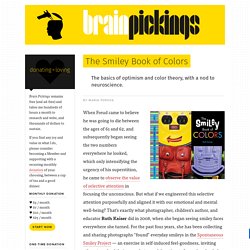
But what if we engineered this selective attention purposefully and aligned it with our emotional and mental well-being? That’s exactly what photographer, children’s author, and educator Ruth Kaiser did in 2008, when she began seeing smiley faces everywhere she turned. For the past four years, she has been collecting and sharing photographs “found” everyday smileys in the Spontaneous Smiley Project — an exercise in self-induced feel-goodness, inviting others to upload their own photos and donating $1 for each uploaded photo to Operation Smile, which provides free surgeries to children born with cleft lip and cleft palate.
Interviews - Sherry Turkle. There seems to be a mass of cheerleaders out there who are celebrating this digital revolution, particularly in education.

I think that we live in techno-enthusiastic times. We celebrate our technologies because people are frightened by the world we've made. The economy isn't going right; there's global warming. In times like that, people imagine science and technology will be able to get it right. “Many students were trained that a good presentation is a PowerPoint -- bam-bam. In the area of education, it calms people to think that technology will be a salvation.
I see part of my role in this conversation as giving nostalgia a good name. You can't put something in its place unless you really have a set of values that you're working from. What is this moment we're in? Where the Books Are. Introducing "enclothed cognition" - how what we wear affects how we think. Whether donning a suit for an interview or a sexy outfit for a date, it's obvious that most of us are well aware of the power of clothing to affect how other people perceive us. But what about the power of our clothes to affect our own thoughts? Relevant to this question is the growing "embodied cognition" literature showing that the position and state of our bodies can affect our thoughts - for example, cleaning their hands makes people feel morally purer . In a new study Hajo Adam and Adam Galinsky propose that clothes can have similar effects on our thoughts - a phenomenon they call "enclothed cognition".
In contrast to embodied cognition effects which are fairly direct, the researchers think enclothed cognition effects will depend on two conditions - first, the symbolic meaning of the clothing and second, the actual wearing of the clothes. To test this idea, the researchers focused on the power of white coats, synonymous with scientists and their attention to detail. How Many of These Words From the Dictionary of American Regional English Do You Know? Ray Bradbury: Literature is the Safety Valve of Civilization. One Person Sharpens Another - Room for Debate. The growing trend for American adults to live alone is one I can understand. After all, it means never having to negotiate over who cleans the bathroom or at what temperature to keep the bedroom.
But is living alone healthier? To answer that question, let’s backtrack a bit and talk about how, as a society, we evolve. Each generation is slightly different from the one before, thanks to either what I would term drifting evolution or intentional evolution. Drifting changes tend to be those that make life immediately easier or more pleasurable but result in regression down the road. Sharing all of life with another person is difficult – but it matures us. The trend toward living alone and even living together without a marriage commitment is a drifting change, based on our desire for immediate comfort and happiness.
Sharing all of life with another person is difficult – but it matures us. Just as our bodies were made for exercise, our souls were made for relationship. The Bomb and the General: A Vintage Semiotic Children's Book by Umberto Eco. By Maria Popova How symbols become symbols, or what keeping atoms in harmony has to do with language acquisition.

Novelist and philosopher Umberto Eco once said that the list is the origin of culture. But his fascination with lists and organization grew out of his longtime love affair with semiotics, the study of signs and symbols as an anthropological sensemaking mechanism for the world. In bridging semiotics with literature, Eco proposed a dichotomy of “open texts,” which allow multiple interpretations, and “closed texts,” defined by a single possible interpretation. Since semiotics is so closely related to language, one of its central inquiries deals with language acquisition — when, why, and how children begin to associate objects with the words that designate those objects. This particular page presents a lovely wink at Brian Cox’s The Quantum Universe, featured here earlier today: Mom is made of atoms. Via the lovely We Too Were Children, Mr. Donating = Loving Share on Tumblr. Family Ties, Without Tying the Knot - Room for Debate.