
Learning through play: pedagogy, challenges and ideas - live chat. Play's vital role in fostering young children's healthy social and psychological development is nowadays a no brainer.
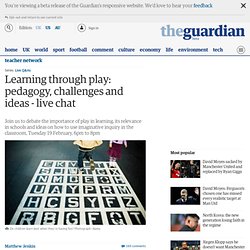
Research by Play England, outlined in its Play for a Change report, found that play not only aids children's mental and physical health, it teaches them risk taking and problem solving skills, promoting imagination, independence and creativity. Play's use in education beyond early years, however, is a much more contentious issue. In a blog about using imaginative inquiry in the classroom, advanced skills teacher and lecturer Tim Taylor argued that children learn best when they're playing.
Mantle of the Expert.com. Imaginative-inquiry. Children learn best when they use their imagination. As a child I loved games.
Playground games, skipping games, card games, board games like Risk and Colditz, obscure data games like Logacta and, most of all, role-play games, where I could imagine being someone else involved in dangerous and exciting adventures. My love of games continued into adulthood and when I became a teacher I wanted to use them in my lessons to engage and excite my students.
In this purpose I was incredibly lucky. As a first year teacher I met Luke Abbott, adviser and former student of drama and education specialist Dorothy Heathcote. Learner led learning research. This is a short version of a complex topic - you'll have to wait for my iBook for the longer version.
Although there are many exceptions, and these are broad generalisations, roughly speaking I would identify three clear sequential phases in post-war educational research: children as subjects - done to them children as co-constructors - done with them children led - done by them Globally, we are just into the last phase in scale, although there is plenty of prior work to confirm how effective it has been already. Creating Classrooms We Need: 8 Ways Into Inquiry Learning.
If kids can access information from sources other than school, and if school is no longer the only place where information lives, what, then happens to the role of this institution?
“Our whole reason for showing up for school has changed, but infrastructure has stayed behind,” said Diana Laufenberg, who taught history at the progressive public school Science Leadership Academy for many years. Laufenberg provided some insight into how she guided students to find their own learning paths at school, and enumerated some of these ideas at SXSWEdu last week. 1. BE FLEXIBLE. The less educators try to control what kids learn, the more students’ voices will be heard and, eventually, their ability to drive their own learning. Mathalicious. Key Board How do you create simple video games?
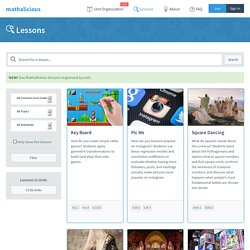
Students apply geometric transformations to build (and play) their own games. Topic: Congruence (CO), Geometry (G) Pic Me How can you become popular on Instagram? F(t): On Writing Lessons for Others. (Cross-posted to Mathalicious Blog) We sat down recently to rewrite the core Xbox Xponential lesson.
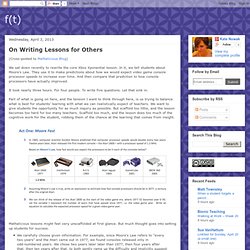
In it, we tell students about Moore's Law. They use it to make predictions about how we would expect video game console processor speeds to increase over time. And then compare that prediction to how console processors have actually improved. It took nearly three hours. Part of what is going on here, and the tension I want to think through here, is us trying to balance what is best for students' learning with what we can realistically expect of teachers. Mathalicious lessons might feel very unscaffolded at first glance. Maths and Mantle of the Expert. Maths and Mantle of the Expert Author: Tim Taylor l Suitable for: Key Stage 2, News, Planning Kevin Holland describes a Creative Partnerships funded project he developed to creating contextualized opportunities to study, apply and develop maths using mantle of the expert.
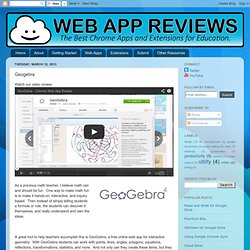
Funded by Creative Partnerships, this was an enquiry schools programme. The focus was on raising attainment in numeracy through a creative approach. As a drama specialist, approaching a numeracy project was going to be new ground for me but I was sure the MOE approach would work. As well as attainment in numeracy rising this term, it was also recognised that mixed ability grouping had a very positive impact. Kevin Holland. Web App Reviews: Geogebra. Watch our video review: As a previous math teacher, I believe math can and should be fun.
E is for Explore! Ken Robinson: Changing education paradigms. 101questions. 101questions Updates, Gets A Lot More Useful. March 25th, 2013 by Dan Meyer I updated 101questions today to include a single major new feature: a lesson editor.
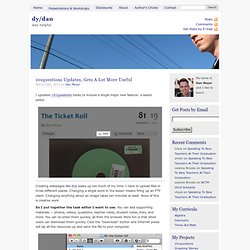
Creating webpages like this soaks up too much of my time. I have to upload files in three different places. Changing a single word in the lesson means firing up an FTP client. Changing anything about an image takes ten minutes at least. So I put together the task editor I want to use. I've been using it for a couple of weeks and I'd like you to use it also. I've added other features some of you have asked for: Better tagging. You can add tags like "pizza" or "basketball" or "money. " A smarter search engine. Dan Meyer: Math class needs a makeover.