Blender. Scientists create artificial mini 'black hole' (PhysOrg.com) -- Scientists from China have built a device that can trap and absorb microwaves coming from all directions with a 99% absorption rate - a property that makes the device simulate, to some extent, an astrophysical black hole.

The scientists, who are from Southeast University in Nanjing, China, explain in their study published in the New Journal of Physics that this is the first experimental demonstration of an omnidirectional electromagnetic absorber in the microwave frequency region. To build the absorber, the researchers used the unique properties of metamaterials to manipulate light waves and achieve the wave trapping and absorbing properties. The device itself is composed of a thin cylinder containing 60 concentric rings of copper-coated metamaterials arranged in layers. Each layer is imprinted with alternating patterns of resonant and non-resonant metamaterial structures. You can now listen to all PhysOrg.com podcasts at phys.org/podcasts-news/ What Keeps Time Moving Forward? Blame It on the Big Bang. Physicists often describe the fabric of the universe we inhabit as four-dimensional spacetime, comprising three dimensions of space and one of time.

But whereas we spend our days passing freely through space in any direction we wish (gravity and solid obstacles permitting), time pushes us along, willingly or not, in a single predetermined direction: toward the future. This is the arrow of time—life carries us from the past, through the present, and into the future. Back to the Future plotlines notwithstanding, no one knows how to reverse the arrow—how to move backward in time—and the logical paradoxes that would result from such a trip into the past render it a thorny proposition at best. (Thanks to a prediction of special relativity called time dilation, travel into the distant future is relatively easy: just move really, really fast.) Entropy, which in rough terms is the measure of a system's disorder, creeps up over time, as dictated by the second law of thermodynamics. Project Tuva: Enhanced Video Player Home. InterScience.
Quantum Physics Online. ArXiv.org e-Print archive. MiePlot. A computer program for scattering of light from a sphere using Mie theory & the Debye series MiePlot was originally designed to provide a simple interface (for PCs using Microsoft Windows) to the classic BHMIE algorithm for Mie scattering from a sphere - as published by Bohren and Huffmann in "Absorption and scattering of light by small particles" (ISBN 0-471-29340-7).
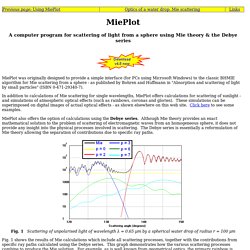
In addition to calculations of Mie scattering for single wavelengths, MiePlot offers calculations for scattering of sunlight - and simulations of atmospheric optical effects (such as rainbows, coronas and glories). These simulations can be superimposed on digital images of actual optical effects - as shown elsewhere on this web site. Click here to see some examples. MiePlot also offers the option of calculations using the Debye series. Fig. 1 Scattering of unpolarised light of wavelength λ = 0.65 µm by a spherical water drop of radius r = 100 µm MiePlot allows the user to select: MiePlot 3.3 contains several new features: Untitled Document. Simon brown. AGEIA. Havok - Home. Maxwell Render ™ : The Light Simulator. Render engine. Multilight ™. Materials. Photorealistic...
CEMOS Home Page. Intelligent plastics change shape with light. Picture a flower that opens when facing the sunlight.

In work that mimics that sensitivity to light, an MIT engineer and his German colleagues have created the first plastics that can be deformed and temporarily fixed into shape by light. These programmed materials change shape when struck by light at certain wavelengths and return to their original shapes when exposed to light of specific different wavelengths. The discovery, to be reported in the April 14 issue of Nature, could have potential applications in a variety of fields, including minimally invasive surgery. Imagine, for example, a "string" of plastic that a doctor could thread into the body through a tiny incision. When activated by light via a fiber-optic probe, that slender string might change into a corkscrew-shaped stent for keeping blood vessels open. What about staples that open at a flash, or paper clips that relax when you don't need them anymore?
Shape memory. Colour Imaging Group.