
How to Succeed Online - Organizing Your Website's Content. Succeeding online isn’t a magic trick and having great web content for your website will definitely help point you in the right direction, but you have to do it right!

In part three of my How to Succeed Online series I am going to discuss how to determine content for your website and how to structure your website’s content into logical groups. I’m going to assume that by now you have read the first two articles in my How to Succeed Online series, “How to Succeed Online – What’s your Plan?” And “Succeed Online – Leave Your Crayons at Home“. If you haven’t, you should go back and read them really quick to get up to speed! How to organize website content for easy navigation.
Justin James offers practical tips on creating a site navigation strategy that effectively guides users/customers to the information or products they are looking for.

If you've ever struggled to find something on a company's Web site without resorting to using a public search engine, you've probably encountered an issue with how the data is organized. Far too many websites have their pages structured in a way that makes sense to them, but not to their visitors. There are a number of causes of this issue, but most of the time, it is that the site either uses a navigation that reflects the company's organization chart, or it is because they are using wording that real-world visitors do not. I am going to show you how to approach your site's content organization to help visitors easily find what they need. The structure of a site is the hardest to correct once the site is in place, so it is best to get it right from the beginning.
Organize Website - Organizing the contents of your website. Logical organization Step back in your mind and get an overview of your website.
Visualize it as an experience rather than a collection of text and graphics. This is where your website begins to take on shape and organization. Your website should be organized, in a logical order, from homepage to endpage. Starting with your main topic or keywords the information you provide, on your webpages, should progress toward more and more detailed content. The information pyramid The homepage (i.e. index) is where your first arguments should appear. The three main elements of website organization There are three main elements that make up the organization of a website. 1) Website structure / navigation The structure of your website and its method of navigation go hand in hand. All types of websites require their own individual website structure.
Organizing Your Information. Our day-to-day professional and social lives rarely demand that we create detailed architectures of what we know and how those structures of information are linked.
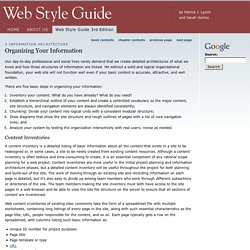
Yet without a solid and logical organizational foundation, your web site will not function well even if your basic content is accurate, attractive, and well written. There are five basic steps in organizing your information: Inventory your content: What do you have already? What do you need? Establish a hierarchical outline of your content and create a controlled vocabulary so the major content, site structure, and navigation elements are always identified consistently;Chunking: Divide your content into logical units with a consistent modular structure;Draw diagrams that show the site structure and rough outlines of pages with a list of core navigation links; andAnalyze your system by testing the organization interactively with real users; revise as needed.
Starting Out Organized: Website Content Planning The Right Way. So many articles explain how to design interfaces, design graphics and deal with clients. But one step in the Web development process is often skipped over or forgotten altogether: content planning . Sometimes called information architecture, or IA planning, this step doesn’t find a home easily in many people’s workflow. But rushing on to programming and pushing pixels makes for content that looks shoehorned rather than fully integrated and will only require late-game revisions. Your New Project: How It Goes All Too Often On day one things are great.
On day two you get the following: And on day three you get an email that makes half of the junk you got yesterday obsolete. You’re only three days in, and the project is already no fun. We know that a great website relies on all parts working in harmony. Allows you to organize deliverables from various media; Lets you rapidly make changes when needed (it’s called planning for a reason: things change!) The Architecture: Every Brick Counts Slides.