
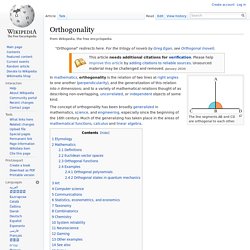
Orthogonality. The line segments AB and CD are orthogonal to each other.
The concept of orthogonality has been broadly generalized in mathematics, science, and engineering, especially since the beginning of the 16th century. Much of the generalizing has taken place in the areas of mathematical functions, calculus and linear algebra. Etymology[edit] The word comes from the Greek ὀρθός (orthos), meaning "upright", and γωνία (gonia), meaning "angle".
The ancient Greek ὀρθογώνιον orthogōnion (< ὀρθός orthos 'upright'[1] + γωνία gōnia 'angle'[2]) and classical Latin orthogonium originally denoted a rectangle.[3] Later, they came to mean a right triangle. Mathematics[edit] Definitions[edit] A set of vectors is called pairwise orthogonal if each pairing of them is orthogonal. In certain cases, the word normal is used to mean orthogonal, particularly in the geometric sense as in the normal to a surface.
A vector space with a bilinear form generalizes the case of an inner product. Euclidean vector spaces[edit] Eigenvalues and eigenvectors. In this shear mapping the red arrow changes direction but the blue arrow does not.
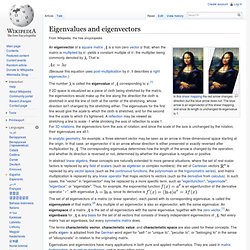
The blue arrow is an eigenvector of this shear mapping, and since its length is unchanged its eigenvalue is 1. An eigenvector of a square matrix that, when the matrix is multiplied by , yields a constant multiple of , the multiplier being commonly denoted by . (Because this equation uses post-multiplication by , it describes a right eigenvector.) The number is called the eigenvalue of corresponding to In analytic geometry, for example, a three-element vector may be seen as an arrow in three-dimensional space starting at the origin. Is an arrow whose direction is either preserved or exactly reversed after multiplication by .
Is an eigenfunction of the derivative operator " ", with eigenvalue , since its derivative is is the set of all eigenvectors with the same eigenvalue, together with the zero vector.[1] An eigenbasis for . Eigenvalues and eigenvectors have many applications in both pure and applied mathematics. Linear Equation Solver. Solving a linear equation system of up to 20 unknowns.
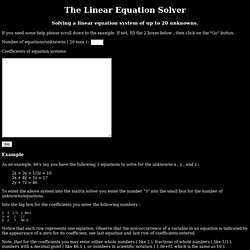
If you need some help please scroll down to the example. If not, fill the 2 boxes below , then click on the "Go" button. Example. Lecture 3: Multiplication and inverse matrices.