
Digital Literacy across the Curriculum handbook. Connecting Literacy Skill Development to the 21st Century. When we were in high school and college, we learned how to use the Dewey decimal system, note cards, microfiche, and setting the margins in an electric typewriter.
We were the last generation of students that actually pounded out papers and research on an electric typewriter and actually memorized the abbreviated guide in the Periodic Guide of Literature as a means to save time. The embodiment of a “good” student in our generation was the ability to ferret out morsels of information that were buried in the library shelves and microfiche drawers.
This took an exceptional amount of time. Digital Literacy in the primary classroom. Image courtesy of Doug Belshaw I've been following the work on Digital Literacy by Doug Belshaw for just over 2 years and I'm still getting my head round what it means to be digitally literate.
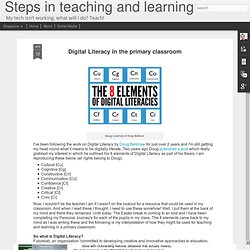
Two years ago Doug published a post which really grabbed my interest in which he outlined his 8 elements of Digital Literacy as part of his thesis. I am reproducing these below (all rights belong to Doug). Cultural [Cu]Cognitive [Cg]Constructive [Cn]Communication [Co]Confidence [Cf]Creative [Cr]Critical [Ct]Civic [Ci] Now, I wouldn't be the teacher I am if I wasn't on the lookout for a resource that could be used in my classroom. So what is Digital Literacy? Futurelab, an organisation 'committed to developing creative and innovative approaches to education, teaching and learning', gives the following definition in its publication Digital Literacy across the curriculum, So how do these 8 elements fit into a primary classroom?
Using Mona Lisa and Shepard Fairey to discuss copyright, fair use, and public domain - Karen Blumberg. Copyright, Plagiarism, and Digital Literacy (by Sue Lyon-Jones. Image credit: PugnoM on Flickr Copyright is a pretty a hot topic in the ELT world at the moment, and many people are discussing it and blogging about it. The law that applies to using lesson materials or blog posts written by other people is complicated, and teachers often find the various issues surrounding copyright confusing. Copyright & Creative Commons Explained by Common Craft. Digital Citizenship Poster for Elementary Classrooms. My Library for copyright. Common Sense on E-rate and CIPA: Toolkits for Schools and Districts. Understanding Copyright, Fair Use, and Creative Commons, as they apply to Education. As we studied this topic in an online course I’m taking, I realized how little I understood it, and figured I wasn’t alone in that regard. After studying this topic in the “Implementing Instructional Technology Innovations” course I am taking online at UW-Stout with instructor Ann Bell, I wanted to understand it even better, since I struggled with it in the fast paced course as we covered it.
Flickr disables Pinterest pins on all copyrighted images (exclusive) As the third most popular source of content on digital pin-board site Pinterest, Flickr and its photographers are subject to frequent acts of copyright infringement.
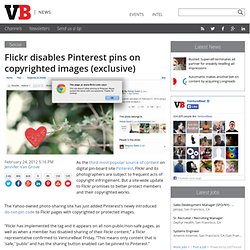
But a site-wide update to Flickr promises to better protect members and their copyrighted works. The Yahoo-owned photo-sharing site has just added Pinterest’s newly introduced do-not-pin code to Flickr pages with copyrighted or protected images. “Flickr has implemented the tag and it appears on all non-public/non-safe pages, as well as when a member has disabled sharing of their Flickr content,” a Flickr representative confirmed to VentureBeat Friday. “This means only content that is ‘safe,’ ‘public’ and has the sharing button enabled can be pinned to Pinterest.” Pinterest, as a refresher, is the digital pin-board site that encourages members to “pin,” via bookmarklet, the products, recipes, clothes, photos, and other items they love to collections called boards. Understanding Creative Commons Licenses. A few years ago, I wrote a novel. It’s not a good novel, but I decided to share it with the world anyway.
To protect it from poachers, I went to Creative Commons and licensed the work . Doing so is very easy–a form walks you through the steps. I really didn’t care if they distributed my work. I didn’t write the novel for profit, but to share it with other people. The Big Idea Behind The Licenses From the Creative Commons website : “The Creative Commons copyright licenses and tools forge a balance inside the traditional “all rights reserved” setting that copyright law creates.
Six License Types There are currently six license types from which you can choose. Other Reading The “open source” licensing approach is currently in version 3.0–having seen its last revision in 2007. There is a very helpful FAQ that can be found here , and a wiki here. How You Could Get Sued For Using Pinterest. The Boston Business Journal stopped using Pinterest one day after setting up its account after realizing it could be sued for images it uploaded to the site.
Web editor Galen Moore started playing around with the rapidly-growing social network on Thursday as a possible way to share the visual images that the Boston Business Journal uses in its coverage of real estate development: things like blueprints, artists conceptions and photos. But by Friday afternoon he had pulled the content after taking a careful read of Pinterest's user agreement and finding out the company reserves the right to sell images users upload.
"Exceptions for publishers of user-generated content protect Pinterest, but they don't protect you," Moore wrote with a link back to an earlier ReadWriteWeb article. The Educator’s Guide to Copyright, Fair Use, and Creative Commons. Lately, we’ve been hearing more and more about digital copyrights and fair use in the news and online – particularly with the whole SOPA/PIPA uproar that recently swept the web.
Also, we on the Edublogs support team have been getting more and more complaints and official requests to remove copyrighted content that users have placed on blogs. The legal jargon with respect to digital copyrights can be confusing – especially since different countries have their own laws and regulations. With this post, we hope to dispel a few myths and pull together a complete list of resources for teachers and students to use when blogging and working with content online. Rule #1: You Can’t Use Everything You Find On the Web Dexter the cat hates those that steal his photos… This may seem obvious, but judging by the notices we have received, many teachers (and especially students) are under the impression that if it is on the web, then it is up for grabs. Rule #2: There Are Resources You CAN Use.