
Product life cycle management (marketing) Product life-cycle management (or PLCM) is the succession of strategies used by business management as a product goes through its life-cycle.

The conditions in which a product is sold (advertising, saturation) changes over time and must be managed as it moves through its succession of stages. The goals of Product Life Cycle (PLC) management are to reduce time to market, improve product quality, reduce prototyping costs, identify potential sales opportunities and revenue contributions, and reduce environmental impacts at end-of-life. To create successful new products the company must understand its customers, markets and competitors. Product lifecycle. Product life cycle is a business analysis that attempts to identify a set of common stages in the life of commercial products.

In other words the 'Product Life cycle' PLC is used to map the lifespan of the product such as the stages through which a product goes during its lifespan.[1] Stages[edit] Schumpeterian growth. Crowd at New York's American Union Bank during a bank run early in the Great Depression.
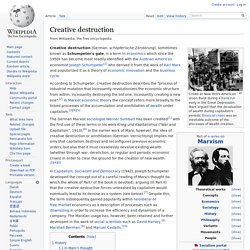
Marx argued that the devaluation of wealth during capitalism's periodic financial crises was an inevitable outcome of the processes of wealth creation. Creative destruction (German: schöpferische Zerstörung), sometimes known as Schumpeter's gale, is a term in economics which since the 1950s has become most readily identified with the Austrian American economist Joseph Schumpeter[1] who derived it from the work of Karl Marx and popularized it as a theory of economic innovation and the business cycle.
Where the Marketing Elite Meet.