
Charles Sanders Peirce. Charles Sanders Peirce (/ˈpɜrs/,[9] like "purse", September 10, 1839 – April 19, 1914) was an American philosopher, logician, mathematician, and scientist, sometimes known as "the father of pragmatism".
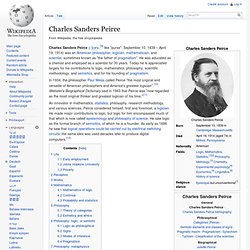
He was educated as a chemist and employed as a scientist for 30 years. Today he is appreciated largely for his contributions to logic, mathematics, philosophy, scientific methodology, and semiotics, and for his founding of pragmatism. An innovator in mathematics, statistics, philosophy, research methodology, and various sciences, Peirce considered himself, first and foremost, a logician. He made major contributions to logic, but logic for him encompassed much of that which is now called epistemology and philosophy of science.
Deductive reasoning. Deductive reasoning links premises with conclusions.
If all premises are true, the terms are clear, and the rules of deductive logic are followed, then the conclusion reached is necessarily true. Deductive reasoning (top-down logic) contrasts with inductive reasoning (bottom-up logic) in the following way: In deductive reasoning, a conclusion is reached reductively by applying general rules that hold over the entirety of a closed domain of discourse, narrowing the range under consideration until only the conclusion(s) is left. In inductive reasoning, the conclusion is reached by generalizing or extrapolating from, i.e., there is epistemic uncertainty. Deductive and Inductive Logic. Logical arguments are usually classified as either 'deductive' or 'inductive'.

Deduction: In the process of deduction, you begin with some statements, called 'premises', that are assumed to be true, you then determine what else would have to be true if the premises are true. For example, you can begin by assuming that God exists, and is good, and then determine what would logically follow from such an assumption. You can begin by assuming that if you think, then you must exist, and work from there.