
Spur. Western-style cowboy spurs with rowels, chap guards and buttons for the spur straps A spur is a metal tool designed to be worn in pairs on the heels of riding boots for the purpose of directing a horse to move forward or laterally while riding.

It is usually used to refine the riding aids (commands) and to back up the natural aids (the leg, seat, hands and voice). The spur is used in every equestrian discipline. There are rules in most equestrian organizations about spur design, use and penalties for using spurs in any manner that constitutes animal abuse. Etymology[edit] The very old word derives from Anglo-Saxon spura, spora, related to spornan, spurnan, to kick, spurn; cf. Design[edit] Parts of a simple spur The parts of a spur include: Spur straps on an English "Prince of Wales" spur. Peartltrees - jeff372037. Barn building with www.barnpros.com how to build a horsebarn. FIRST DRAFT - Founder - jeff372037. How to Grow a Long, Thick Mane and Tail on ANY Horse Lightning FAST!
Finally The SECRETS To Gorgeous Horses! "Now You Too Can Grow Long, Thick, Luxurious Manes and Tails and Make ANY Horse Stunningly Gorgeous Amazingly Fast!! " It's True, I Promise, -I Even Guarantee It! If you think it's not possible to transform your horse this FAST, then keep reading... I promise that you'll be amazed at how quick, easy (and cheap!) It is for you to grow 3" to 4" of thick, luxurious length every month once you know the secret.
At every horse show that I go to, and every trail ride I go on, I get asked how I get my horses' manes and tails so long and thick and beautiful. It's Finally REVEALED... What Took Me Years and Years of Hard Work With a Top Trainer... Introducing My New Online Course... Horse colic - Google Search. Hide and seek - How to identify quality leather. By Neil Clarkson on Oct 23, 2012 in Features What is full-grain leather?

What does currying and stuffing mean? Neil Clarkson investigates the ancient art of leather-making, and explains how to tell the good stuff from the bad when choosing tack. It’s a delicious smell like no other, wafting up to greet as you stand at the racks of saddles and other leather gear at your local saddlery. History of Western Saddles. Western saddles have had a long and interesting history.

This saddle, usually considered uniquely American, can actually be traced back to medieval knights and Moorish riders. Read on to find out where the western saddle came from and how it got its modern shape. Along with Moorish invaders, a unique style of tack and riding came to Spain in the early medieval period. These saddles had high forks and cantles and longer stirrups. These allowed armored riders to stay in the saddle more effectively, and were soon adopted by the majority.
This saddle came with the conquistadors to the New World, and this military saddle eventually became the stock saddle used by working cowboys in the colonies. On the Pacific Coast, the Californio style was more popular. The western saddles of the 1700s were relatively primative. Stirrup. A stirrup is a light frame or ring that holds the foot of a rider, attached to the saddle by a strap, often called a stirrup leather.
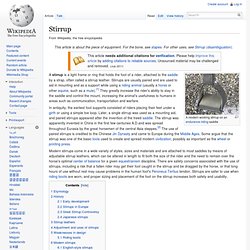
Stirrups are usually paired and are used to aid in mounting and as a support while using a riding animal (usually a horse or other equine, such as a mule).[1] They greatly increase the rider's ability to stay in the saddle and control the mount, increasing the animal's usefulness to humans in areas such as communication, transportation and warfare. Etymology[edit] Adjusting Stirrups on Western Saddle. One thing that you would want to do especially if you are riding in a western saddle for the first time is make sure your stirrups are the proper length.

You would want your stirrup a little bit longer than you would in a English saddle. So you would want your stirrup just a little bit longer then the length of your arm. If you do need to adjust it underneath your stirrup fender, there is going to be a buckle here which you can slide up. There is a little buckle that comes out which you could move up or down into the holes to adjust it accordingly to your length. Then you slide this buckle down back over it. Bit (horse) A horse wearing an English bridle with a snaffle bit and a cavesson Although there are hundreds of design variations, the basic families of bits are defined by the way in which they use or do not use leverage.

They include: Bits are further described by the style of mouthpiece that goes inside the horse's mouth as well as by the type of bit ring or bit shank that is outside the mouth, to which the reins are attached. Types of headgear for horses that exert control with a noseband rather than a bit are usually called hackamores,[3] though the term "bitless bridle" has become a popular colloquialism in recent years. The first bits were made of rope, bone, horn, or hard wood. Throughout history, the need for control of horses in warfare drove extensive innovation in bit design, producing a variety of prototypes and styles over the centuries, from Ancient Greece into modern day use.[10] Often, bits with shanks and single- or double-jointed mouthpieces are incorrectly referred to as snaffles.