
Chris Dixon, The Pirate In The Arena. Building a Sustainable Future. Steve Jobs's Legacy - And The Next Tech War. In a few days Fast Company’s next magazine issue will begin arriving in newsstands and mailboxes. The issue has four different covers, and one of them features a picture of Steve Jobs. But this is not a commemorative obituary. In fact, the issue had already been printed at our plant when Jobs passed away. Instead the magazine offers a forward-looking analysis of what’s next for Apple--and how it will be battling with America’s three other favorite tech companies: Amazon, Facebook, and Google.
We’ve dubbed this coming clash “The Great Tech War of 2012.” These four companies are increasingly crossing into each others’ spheres. Our four covers feature Steve Jobs, Facebook’s Mark Zuckerberg, Google CEO Larry Page, and Amazon chief Jeff Bezos. Steve Jobs has had an outsize impact on our culture. Competitors like Facebook, Google, and Amazon have also learned from Jobs, as commentary across the business world has echoed since his passing. Where do ideas come from? Where do ideas come from?
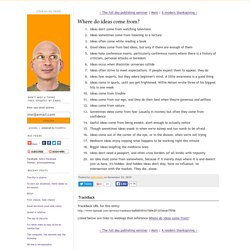
Ideas don't come from watching televisionIdeas sometimes come from listening to a lectureIdeas often come while reading a bookGood ideas come from bad ideas, but only if there are enough of themIdeas hate conference rooms, particularly conference rooms where there is a history of criticism, personal attacks or boredomIdeas occur when dissimilar universes collideIdeas often strive to meet expectations. If people expect them to appear, they doIdeas fear experts, but they adore beginner's mind. A little awareness is a good thingIdeas come in spurts, until you get frightened. When Ideas Have Sex. This is the first post in a new series, produced by Frog Design, drawn from their publication, Design Mind.

The theme of the current issue -- from which this essay is drawn -- is "And Now the Good News. " It presents ideas flowing from the most recent TED Global conference. As I write this, two artifacts of roughly the same size and shape sit on my desk: a cordless mouse and a hand axe from the Middle Stone Age. Both are designed to fit the human grip. Both are technologies. The hand axe represents a technology that did not change for a million years; it evolved slower than the human skeleton.
And yet, it is the mouse, not the hand axe, that is the key to understanding why human beings dominate the planet and why there has been such explosive prosperity and progress over the past 100,000 years. Cooperation turned us into specialists: I'll do this job, you do that one. 8 Predictions for IT in 2015 From Gartner. Gartner today announced eight predictions for IT in 2015.

Last week, we looked at the broad trends Gartner and two other analyst firms expect to shape the future of IT. This latest announcement makes some more specific predictions about changes the firm's analysts expect to see by 2015 or earlier. For example, the firm predicts that 80% of enterprises will support tablets by 2013 and by 2014 90% of organizations will support enterprise applications on personal devices. The predictions are as follows: By 2015, a G20 nation's critical infrastructure will be disrupted and damaged by online sabotage. The second prediction, that revenue generated by IT will be a CIO compensation factor, is the most interesting to me. What do you think of these predictions?
Trends: Influencers Aspire For Market Maker Status. Eight Major Influencer Types Exist Today Analyst relations, public relations, influencer relations and other interested parties have witnessed the rapidly evolving and emerging buy-side and market influencer models.

In the past, eight influencer types followed five distinct traits (see Figure 1): Fame. Awareness, notoriety, perceived market status.Fortune. Billing rates, wealth, earnings.Market impact. Figure 1. Influencer Types Converge As Firms Seek Survival And Maintain Relevance However, changing influencer economics over the past 5 years have forced convergence among the eight major influencer types (see Figure 2.). Events producers have fallen neatly into the hands of media moguls. Figure 2. The Bottom Line: Influencers Will Adopt Multiple Influencer Types to Earn Market Maker Status Market makers create tremendous influence in the market. Your POV.