
Salmon Protocol for Distributed, Real-Time Content Expands with. The Internet is a mess these days.

Conversations are distributed and fragmented; a blog post's comments will almost surely appear on a number of sites other than the author's blog. Considering factors from Facebook shares, likes, and posts to comments on Google Reader or even content curators such as Hacker News, site owners have found it increasingly difficult over the past year or so to efficiently and effectively collect all the sentiments, media, entities, and data associated with any given piece of content. Salmon is a protocol that addresses this specific issue, and engineer John Panzer has begun an open-source project to help unify the conversations of the synaptic web. Wrote Panzer on his blog, "A few days ago at the Real Time Web Summit, we had a session about Salmon, a protocol for re-aggregated distributed conversations around web content.
Alternate) DuckTales TV Intro. Simple process to estimate times and costs in a web project. After my previous article about a structured process to develop a web application I received some requests from my readers which asked to me to dedicate a post about how to estimate times and costs of a web project.
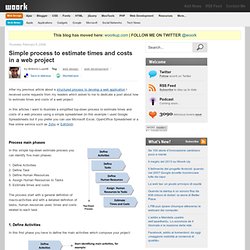
In this articles I want to illustrate a simplified top-down process to estimate times and costs of a web process using a simple spreadsheet (in this example I used Google Spreadsheets but if you prefer you can use Microsoft Excel, OpenOffice Spreadsheet or a free online service such as Zoho or EditGrid). Process main phases In this simple top-down estimate process you can identify five main phases: 1. Define Activities 2.