
Hyperion Cantos. Cordwainer Smith. Cordwainer Smith (pronounced CORDwainer)[1] was the pseudonym used by American author Paul Myron Anthony Linebarger (July 11, 1913 – August 6, 1966) for his science fiction works.

Linebarger was a noted East Asia scholar and expert in psychological warfare. ("Cordwainer" is an archaic word for "A worker in cordwain or cordovan leather; a shoemaker",[2] and a "smith" is "One who works in iron or other metals; esp. a blacksmith or farrier":[2] two kinds of skilled workers with traditional materials.) Early life and education[edit] Linebarger was born in Milwaukee, Wisconsin.
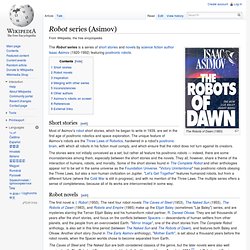
His father was Paul M. As a child, Linebarger was blinded in his right eye; the vision in his remaining eye was impaired by infection. At the age of 23, he received a PhD in Political Science from Johns Hopkins University. Career[edit] From 1937 to 1946, Linebarger held a faculty appointment at Duke University, where he began producing highly regarded works on Far Eastern affairs. Robot series (Asimov) The Robots of Dawn (1983) The Robot series is a series of short stories and novels by science fiction author Isaac Asimov (1920-1992) featuring positronic robots.
Most of Asimov's robot short stories, which he began to write in 1939, are set in the first age of positronic robotics and space exploration. The unique feature of Asimov's robots are the Three Laws of Robotics, hardwired in a robot's positronic brain, with which all robots in his fiction must comply, and which ensure that the robot does not turn against its creators. The Caves of Steel and The Naked Sun are both considered classics of the genre, but the later novels were also well received, with The Robots of Dawn nominated for both the Hugo and Locus Awards in 1984,[1] and Robots and Empire shortlisted for the Locus Award for Best Science Fiction Novel in 1986.[2] Asimov later integrated the Robot Series into his all-engulfing Foundation series, making R.
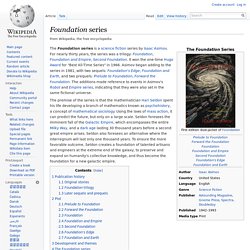
Another inconsistency is the positronic brain development. Foundation series. Publication history[edit] Original stories[edit] Foundation trilogy[edit] Later sequels and prequels[edit] In 1981, Asimov was persuaded by his publishers to write a fourth book, which became Foundation's Edge (1982).[3] Four years later, Asimov followed up with yet another sequel, Foundation and Earth (1986), which was followed by the prequels Prelude to Foundation (1988) and Forward the Foundation (1993).
Plot[edit] Prelude to Foundation[edit] Prelude to Foundation opens on the planet Trantor, the empire's capital planet, the day after Hari Seldon has given a speech at a conference. Throughout their adventures all over Trantor, Seldon continuously denies that psychohistory is a realistic science. Forward the Foundation[edit]