
Soil scientist researches nature versus nurture in microorganisms. A West Virginia University researcher used science and data to solve the timeless argument of nature versus nurture—at least when it comes to microorganisms.

Ember Morrissey, assistant professor of environmental microbiology in the Davis College of Agriculture, Natural Resources and Design, uncovered that nature significantly affects how the tiny organisms under our feet respond to their current surroundings. "We found that evolutionary history (nature) shapes the traits of microbes in the soil more than their local environment (nurture)," she said. "I'm hopeful that we can use that information to make predictions about undiscovered species and organisms. " Microorganisms cycle nutrients and play a vital role in the carbon cycle. According to Morrissey, understanding them better will help inform decisions related to fighting climate change.
"Soils contains more carbon than what is found in the atmosphere and plants," she explained. More information: Ember M. New paper points to soil pore structure as key to carbon storage. Alexandra Kravchenko, Michigan State University professor in the Department of Plant, Soil and Microbial Sciences, and several of her colleagues recently discovered a new mechanism determining how carbon is stored in soils that could improve the climate resilience of cropping systems and also reduce their carbon footprints.

The findings, published last week in the scientific journal Nature Communications, reveal the importance of soil pore structure for stimulating soil carbon accumulation and protection. "Understanding how carbon is stored in soils is important for thinking about solutions for climate change," said Phil Robertson, University Distinguished Professor of Plant, Soil and Microbial Sciences, and a co-author of the study. "It's also pretty important for ways to think about soil fertility and therefore, crop production. " The study was conducted through the MSU Great Lakes Bioenergy Research Center, funded by the U.S. Root exudates affect soil stability, water repellency: Research digs into delicate plant, soil interactions. As the growing season progresses, you might not notice much about what's happening to plants under the soil.

Most of us pay attention to new shoots, stems, leaves, and eventually the flowers and crop we intend to grow. We might think of roots as necessary, but uninteresting, parts of the crop production process. Paul Hallett and his team disagree. Krasil'nikov: TOC. Academy of Sciences of the USSR Institute of Microbiology N.

A. Krasil'nikov Published by the Academy of Sciences of the USSR Moscow 1958 Published for THE NATIONAL SCIENCE FOUNDATION, WASHINGTON, D.C. Title of Russian Original: Mikroorganizmy pochvy i vysshie rasteniva Translated by: Dr. Printed in Jerusalem by: S. Table of Contents Introduction Part 1. International Biochar Initiative. Collection: Mollison's Permaculture Principles. Free eBooks Archive - Permaculture Media Blog. See also: On the Duty of Civil Disobedience by Henry David Thoreau - Civil Disobedience is an essay by Henry David Thoreau that was first published in 1849.
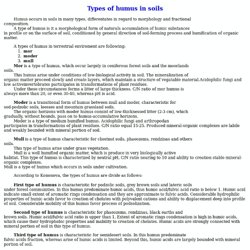
It argues that people should not permit governments to overrule or atrophy their consciences, and that people have a duty to avoid allowing such acquiescence to enable the government to make them the agents of injustice. Thoreau was motivated in part by his disgust with slavery and the Mexican-American War. Permaculture Principles - thinking tools for an era of change. Organic. Types of humus in soils. Humus occurs in soils in many types, differentates in regard to morphology and fractional composition.
Understanding the Soil. Quotes from Understanding the Soil Processes Most of us will agree that the soil is the major natural resource available to mankind.

Yet it is and has been abused by us to the point of self destruction. Many past civilizations have perished due to their abuse of the soil (like Mesopotamia and the Mayan civilization). Why didn't anyone stop the destruction?
Practical Plants. Polycultures, Guilds & Companions...
In addition to each plant being able to record interactions with other individual plants, users can also create polycultures or guilds of known plant combinations that work well together. Soil Texture to Soil Food Web. Life in the Soil. Soil. Fast compost - Soil Permaculture Design and Maintenance Permaculture Research Institute. What is Compost?
Compost is humanity’s version of the humus found in nature, and the compost heap is a ‘digester’ – our tool used to produce it. Humus is made of broken down vegetation which releases nutrients back into the soil for healthy plant growth. Similarly, under the direction of the careful gardener, the composting process breaks down a rich mixture of ingredients to produce a potent humus which will regenerate soil and foster vigorous plant growth.
Virtually anything which has once lived can be composted – although selecting the most appropriate mixture of ingredients from what is available can be seen at first as something of a ‘dark art’. Time spent in quiet observation of the natural processes of your garden will never be wasted. Why make Compost? Strong and healthy plants have their own natural resistance to pests and diseases and compost is the natural, home grown, method of achieving this. How to make Compost Material C/N ratio Method (for a ‘hot’ heap) How it works. Nitrogen Cycle Summary. Nitrogen is an important structural component of many necessary compounds, particularly proteins.

Atmosphere is the reservoir of free gaseous nitrogen and nitrogen compounds are found in bodies of organisms and in the soil. Living organisms cannot pickup elemental gaseous nitrogen directly from the atmosphere (except for nitrogen fixing bacteria). It has to be converted into nitrates to be utilised by plants. Nitrogen cycling involves several stages: Conversion of nitrogen into nitrates is called nitrogen fixation. 1) Atmospheric nitrogen fixation 2) Biological nitrogen fixation 3) Industrial nitrogen fixation. Soil Science Education - How Does Your Garden Grow? International Biochar Initiative.