
Coats and Robes for Sale From Twin Roses Designs! Costume Design and Construction by Andrea Wakely. Whether for a night cruising the bars on Tatooine or battling Sith Lords, these Jedi robes are the perfect way to start or complete a Jedi inspired costume!
These unlined robes feature oversized hoods, bell sleeves and professionally finished seams. For your reference, the models are about 6 feet tall with 40 - 42 inch chest. These robes open all the way down the front and there are no front closures - if you need a closure at the neckline or have sizing questions, please contact us.
Our robe measurement chart is located on our Custom Orders page. These robes are intended to be 'generic' Sith and Jedi style - if you have a particular character you are trying to emulate or specific details you wish to have incorporated into your robe contact us for a custom order with your detailed specifications and which character so that we can provide you with a price quote. These can be shortened to your specified length after purchase at no additional charge. Clone Yourself A Fitting Assistant. David Coffin Duct-tape dress form (above) uses ordinary duct-tape as both the body-casting material and the final form.
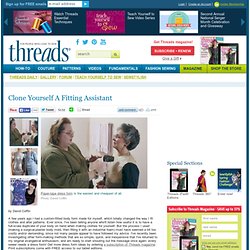
Another version of this Duct-tape dress form (not shown) is a bit more difficult but produces a closer fit. Check out this updated method for creating the ultimate fitting assistant. Sloan Howard by David Coffin A few years ago I had a custom-fitted body form made for myself, which totally changed the way I fit clothes and alter patterns. What's so earthshaking about having a clone in the sewing room?
Minor adjustments become so easy and obvious when you're looking at the actual problem in fabric on "yourself" that you often don't even need a muslin or a corrected pattern. Armormaking for the Fiberglass Phobic. Plate armour. The use of plate armour declined in the 17th century, but remained common both among the nobility and for the cuirassiers throughout the European wars of religion.
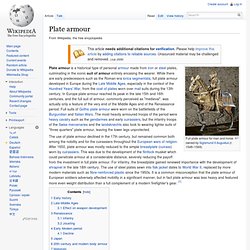
After 1650, plate armour was mostly reduced to the simple breastplate (cuirass) worn by cuirassiers. This was due to the development of the flintlock musket which could penetrate armour at a considerable distance, severely reducing the payoff from the investment in full plate armour. For infantry, the breastplate gained renewed importance with the development of shrapnel in the late 18th century. The use of steel plates sewn into flak jacket dates to World War II, replaced by more modern materials such as fibre-reinforced plastic since the 1950s. It is a common misconception that the plate armour of European soldiers adversely affected mobility in a significant manner, but in fact plate armour was less heavy and featured more even weight distribution than a full complement of a modern firefighter's gear. [1] Renaissance[edit]
Medieval Suit of Armor. The transition from chainmaille armour to plate armour seems to have taken place in the 13th century.
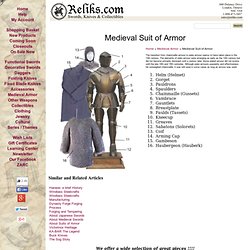
The elements of plate armour were emerging as early as the 12th century but did not become primarily dominant until a century later. Some plated armour did not evolve until the late 14th and 15th centuries. Although plate armours popularity and effectiveness far outweighed chainmaille, it was still used in some cases as long as armour was used. Helm (Helmet) Gorget PauldronsSpaulders Chainmaille (Gussets)VambraceGauntletsBreastplate Faulds (Tassets)KneecupGreavesSabatons (Solorets)CoifArming CapGambesonHaubergeon (Hauberk) Sintra sheets information. Sintra® is available in thicknesses from 1mm to 19mm (but 3mm and 6mm are the most common), and a dozen colors (white is available in all thicknesses, the other colors just in 3mm and 6mm; more about colors later).
As a result of its structure, Sintra® has a number of useful properties . High stiffness Light weight -- half the weight of solid PVC in gauges of 1 - 6mm, slightly over one third the weight of solid PVC in 10mm and thicker gauges Resistance to moisture and many chemicals Smooth solid faces -- just the ticket for ease of finishing, as well as resistance to grime buildup Easy to work with (but more on this below) Cutting, machining, and formingSintra® can be shaped much like wood. Pieces up to 3mm thick can be cut with a good shop knife; 6mm sheet can be scored with a knife and snapped on the score line.