
How to Overcome Immunity to Change. By Jessie Sholl / May 2011: Unstoppable!

Most of us have changes we’d like to make in our lives, from our work and finances to our health and relationships. But often, despite years of effort, we don’t get very far. So, what’s standing in our way? Two Harvard researchers, Robert Kegan, PhD, and Lisa Laskow Lahey, EdD, believe they have cracked the code. And they’ve used their discoveries to develop a process that helps people overcome ingrained obstacles and successfully make what’s known in psychological circles as “adaptive change.” Adaptive change requires a shift in mindset, not just behavior.
A Change of the Guard. Www.elenaaguilar.com. Why a Happy Brain Performs Better - HBR IdeaCast. Featured Guest: Shawn Achor, CEO of Aspirant and author of The Happiness Advantage: The Seven Principles of Positive Psychology That Fuel Success and Performance at Work.
Download this podcast SARAH GREEN: Welcome to the HBR IdeaCast from Harvard Business Review. I’m Sarah Green. I’m talking today with Shawn Achor, author other of The Happiness Advantage, and CEO of Aspirant, a research and consulting firm that uses positive psychology to improve performance at work. Shawn, thanks so much for taking the time to talk with us today. SHAWN ACHOR: Thank you so much for having me. SARAH GREEN: Shawn, the roots of your book go back to when you were the head teaching fellow of the landmark happiness class at Harvard College with Dr.
There have been several major articles in major magazines, there have been several books published saying that positive psychology is undermining America, or it’s not all it’s cracked up to be. And all that’s wrapped around something that I call irrational optimism. SCARF Model - Influencing Others with Dr David Rock. Empathy: the Key to Social and Emotional Learning. Big Ideas Culture Educators are aware that social problems like poverty, unsafe neighborhoods, violence, and family trauma can affect how students learn when they come to school.

Though teaching subjects like math and literacy are the biggest part of their job, in many cases they’re also called on to attend to their students’ emotional health as well, incorporating social and emotional skills. “Science is starting to show that there is a very strong integration between social and emotional skills and learning,” said Vicki Zakrzewski, education director of the Greater Good Science Center at U.C. Berkeley, which studies the psychology, sociology and neuroscience of well-being during a recent Forum radio show. “Some scientists believe that cognitive achievement is 50 percent of the equation and social and emotional skills are the other 50 percent.” Some school districts are taking that idea seriously and integrating the research into teaching practices. Related. Brain Aging Linked to Sleep-Related Memory Decline. Four Ways to Give Good Feedback. When effectively administered, feedback is a powerful way to build knowledge and skills, increase skills, increase motivation, and develop reflective habits of mind in students and employees.
Too often, however, the feedback we give (and get) is ineffectual or even counterproductive. Here, four ways to offer feedback that really makes a difference, drawn from research in psychology and cognitive science: 1. Supply information about what the learner is doing, rather than simply praise or criticism.In “The Power of Feedback,” an article published in the Review of Educational Research in 2007, authors John Hattie and Helen Timperley point out that specific information about how the learner is performing a task is much more helpful than mere praise or, especially, criticism. (MORE: Secrets of the Most Successful College Students) 2. According to Deci, a third feedback condition that can reduce learners’ engagement is an uncomfortable sense of competition. 3. 4. How to Give Effective Feedback, Both Positive and Negative. NeuroLeadership Institute’s Chief, on Shared Goals. The Power of Peer Coaching. Megan Tschannen-Moran's Web Site. Dr.
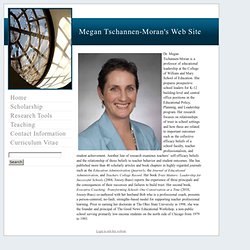
Megan Tschannen-Moran is a professor of educational leadership at the College of William and Mary School of Education. She prepares prospective school leaders for K-12 building-level and central office positions in the Educational Policy, Planning, and Leadership program. Brain-related research. Mirror Neurons. Mirror Neurons PBS air date: January 25, 2005 ROBERT KRULWICH: Hello again.
Tips for Making Decisions, and Sticking to Them. Thinking, Fast and Slow — By Daniel Kahneman — Book Review. Human irrationality is Kahneman’s great theme.
There are essentially three phases to his career. In the first, he and Tversky did a series of ingenious experiments that revealed twenty or so “cognitive biases” — unconscious errors of reasoning that distort our judgment of the world. Typical of these is the “anchoring effect”: our tendency to be influenced by irrelevant numbers that we happen to be exposed to.
(In one experiment, for instance, experienced German judges were inclined to give a shoplifter a longer sentence if they had just rolled a pair of dice loaded to give a high number.) In the second phase, Kahneman and Tversky showed that people making decisions under uncertain conditions do not behave in the way that economic models have traditionally assumed; they do not “maximize utility.”