
Scott Chacon on the Interwebs. August 31, 2011 Issues with git-flow I travel all over the place teaching Git to people and nearly every class and workshop I’ve done recently has asked me what I think about git-flow.

I always answer that I think that it’s great - it has taken a system (Git) that has a million possible workflows and documented a well tested, flexible workflow that works for lots of developers in a fairly straightforward manner. It has become something of a standard so that developers can move between projects or companies and be familiar with this standardized workflow. However, it does have its issues. One of the bigger issues for me is that it’s more complicated than I think most developers and development teams actually require. Both of these issues can be solved easily just by having a much more simplified process. Its simplicity gives it a number of advantages. GitHub Flow.
The Secret Life of JavaScript Primitives. You may not know it but, in JavaScript, whenever you interact with string, number or boolean primitives you enter a hidden world of object shadows and coercion.
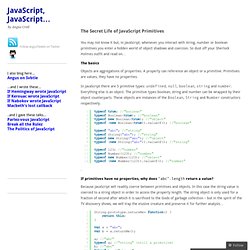
So dust off your Sherlock Holmes outfit and read on… The basics Objects are aggregations of properties. A property can reference an object or a primitive. Primitives are values, they have no properties. In JavaScript there are 5 primitive types: undefined, null, boolean, string and number. If primitives have no properties, why does "abc".length return a value?
Because JavaScript will readily coerce between primitives and objects. …and as with many well meaning scientific investigations we have now interfered with the natural progression of things and prevented the object from being garbage collected so long as b is around. (Note that in strict mode, the elusive creature gets away – thanks @DmitrySoshnikov) Here’s a more environmentally responsible example that verifies the object type without interfering with garbage collection: . Ai.cs.washington.edu/www/media/papers/reverb.pdf. Patterns For Large-Scale JavaScript Application Architecture. Today we're going to discuss an effective set of patterns for large-scale JavaScript application architecture.

The material is based on my talk of the same name, last presented at LondonJS and inspired by previous work by Nicholas Zakas. Who am I and why am I writing about this topic? I'm currently a JavaScript and UI developer at AOL helping to plan and write the front-end architecture to our next generation of client-facing applications. As these applications are both complex and often require an architecture that is scalable and highly-reusable, it's one of my responsibilities to ensure the patterns used to implement such applications are as sustainable as possible. I also consider myself something of a design pattern enthusiast (although there are far more knowledgeable experts on this topic than I).
Can you summarize this article in 140 characters? In the event of you being short for time, here's the tweet-sized summary of this article: