
Bio 301 Laboratories. IBNeuro - Neuropsicologia. Learn to Draw: Drawing on the Right Side of the Brain. LucidQuest Audio Brainwave Entrainment - Sonic Art & Engineering for the Brain/Mind. Neurorede - Rede Social Colaborativa de Neurociências. Sistema Nervoso. SISTEMA NERVOSO. Society for Neuroscience. Sociedade Brasileira de Neurociências e Comportamento - Sociedade Brasileira de Neurociências e Comportamento.
Latin America Region. Neuroscience Information Framework. The Whole Brain Atlas. Nosso Nobel « Link. Miguel Nicolelis: "Quero fazer um tetraplégico dar o pontapé inicial da Copa de 2014" Por Rafael Cabral Miguel Nicolelis não precisa ser reconhecido por mais ninguém – e nem ganhar o Nobel no qual é listado como eterno candidato – para provar que é o cientista brasileiro mais importante hoje.
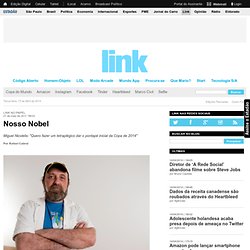
O paulistano da Bela Vista ganhou no ano passado um prêmio de mais de US$ 2,5 milhões (R$ 4,4 milhões) dos Institutos Nacionais de Saúde dos EUA (NIH, na sigla em inglês) que, distribuído ao longo de cinco anos, financiará sua pesquisa sobre a fusão entre homens e máquinas, cujos resultados vêm devolvendo a esperança para tetraplégicos e pacientes de Parkinson. Agora, ele se prepara para finalizar seus dois maiores projetos na vida: a construção de um polo de ciência em Macaíba, Natal, e a finalização de uma veste robótica que poderá fazer que tetraplégicos voltem a andar, usando só a força do pensamento. E, se tudo parece dar certo, o Nobel também parece mais próximo. Miguel Nicolelis - The Daily Show with Jon Stewart - 03/29. Neuroanatomy/Neurophysiology Course. Cellular Neurophysiology OpenCourseWare: MIT's Free Undergraduate Biological Sciences Course on Neuronal Communication.
Neuro courses. Related Resources for course Introduction to Neuroanatomy - Online Course information from HigherEdSpace.com. Functional Neuroanatomy- Free Online Course. NAN DISTANCE. Neuropsychology course. Cognitive neuropsychology is the area of psychology that studies brain-damaged patients to understand the workings of our brain.
Our brain is constructed of two hemispheres which are responsible for different facets of human personality and behaviour. Despite some essential differences in some functions, these hemispheres communicate through inter-hemispheric neural connections, most through the corpus callosum. This communication allows the brain to integrate different elements to produce coordinated, apparently seamless action and a unified personality Our behaviour, personality and thought processes are affected by neurobiological processes and can be altered by any damage to our nervous system. Intensive Neuroanatomy.
Free Online Neuropsychology Courses. Prosopagnosia Research Centers. Cognition Laboratory Experiments. Fundamentals of Neuroanatomy Video Lecture Course. Neuroscience Animations: John H. Krantz, Ph.D. Hanover College. Brain_Learning. Neuropsychology. UAI - Uncertainty in Artificial Intelligence. BrainSCANr. Folder - Neuropsicologia. Folder - Neuropsicologia hoje. Files Photo Music Books Video Games Sign Up.
Folder - Neurociências e TCC. Behavioral and Brain Functions. Brain rhythm predicts ability to sleep through a noisy night. Ever wonder why some people can sleep through just about anything, while others get startled awake at each and every bump in the night?
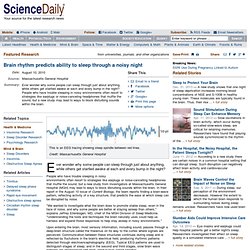
People who have trouble sleeping in noisy environments often resort to strategies like earplugs or noise-cancelling headphones that muffle the sound, but a new study from investigators at Massachusetts General Hospital (MGH) may lead to ways to block disturbing sounds within the brain. In their report in the August 10 issue of Current Biology, the team reports finding a brain-wave pattern, reflecting activity of a key structure, that predicts the ease at which sleep can be disrupted by noise.
"We wanted to investigate what the brain does to promote stable sleep, even in the face of noise, and why some people are better at staying asleep than others," explains Jeffrey Ellenbogen, MD, chief of the MGH Division of Sleep Medicine. A piece of advice for those who really must go to sleep with the radio or TV on: use a timer. THE ANATOMICAL BASIS OF MIND. A neurocientista de plantão - A neurocientista de plantão - Uma ode ao cérebro.
Blog - Núcleo de Experimentos em Neurociências. National Institute of Neurological Disorders and Stroke (NINDS) Normal Anatomy. Science 2.0. On Intelligence - Table of Contents. Shurvon Phillip, The Sergeant Lost Within - Iraq - Brain Injuries - Roadside Bombs. The brain scan that can read people's intentions. A team of world-leading neuroscientists has developed a powerful technique that allows them to look deep inside a person's brain and read their intentions before they act.
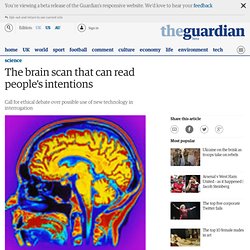
The research breaks controversial new ground in scientists' ability to probe people's minds and eavesdrop on their thoughts, and raises serious ethical issues over how brain-reading technology may be used in the future. The team used high-resolution brain scans to identify patterns of activity before translating them into meaningful thoughts, revealing what a person planned to do in the near future. It is the first time scientists have succeeded in reading intentions in this way. "Using the scanner, we could look around the brain for this information and read out something that from the outside there's no way you could possibly tell is in there.
The research builds on a series of recent studies in which brain imaging has been used to identify tell-tale activity linked to lying, violent behaviour and racial prejudice. Whole Brain Catalog. Neuroscience Blogs. Neuroskeptic. This Is Your Brain on Metaphors. Neuroscience. Blog da Sociedade Brasileira de Neurociências e Comportamento. Can mental activity protect against memory problems in multiple sclerosis?
A new study shows that a mentally active lifestyle may protect against the memory and learning problems that often occur in multiple sclerosis (MS).
The study is published in the June 15, 2010, print issue of Neurology®, the medical journal of the American Academy of Neurology. "Many people with MS struggle with learning and memory problems. This study shows that a mentally active lifestyle might reduce the harmful effects of brain damage on learning and memory. N E U R O L A B - Artigos de Neurociência e Neurologia Online. Neuropsychological Assessment, Diagnostics and Cognitive Rehabilitation Therapy. Traumatic Brain Injury - TBI & Head Injury Resource. Brain Basics - 3D Model of Brain Injury. Animated Deceleration Injury from a Traumatic Brain Injury TBI Inform: Introduction to Brain Injury What Happens When a Brain Bleeds?
Areas of the Brain Affected by Concussion What is Chronic Traumatic Encephalopathy? Concussion Recovery The brain is incredibly complex. Located behind the forehead, the frontal lobes are the largest lobes of the brain. Planning organizing problem solving memory impulse control decision making selective attention controlling our behavior and emotions The left frontal lobe plays a large role in speech and language. Brain Injury Lawyer & Attorney : Bruce H. Stern. Neurociencias. THE BRAIN FROM TOP TO BOTTOM. For many years, scientists’ understanding of how the brain processes language was rather simple: they believed that Wernicke’s area interpreted the words that we hear or read, then relayed this information via a dense bundle of fibres to Broca’s area, which generated any words that we spoke in response. But subsequent experiments with brain imaging have revealed the existence of a third region of the brain that is also indispensable for language.
This region is the inferior parietal lobule, also known as “Geschwind’s territory”, in honour of the American neurologist Norman Geschwind, who foresaw its importance as early as the 1960s. Brain imaging studies have now shown that the inferior parietal lobule (angular gyrus and supramarginal gyrus) is connected by large bundles of nerve fibres to both Broca’s area and Wernicke’s area. The inferior parietal lobule is one of the last structures of the human brain to have developed in the course of evolution. Behavioral and Brain Functions. LE CERVEAU ? TOUS LES NIVEAUX! Neuromarketing. Neuromarketing. Prosopagnosia, hereditary. Untitled Document. Scientists Use Scans to Better Understand Brain Maturity. As children mature, their brains bloom madly with activity — growing, pruning and rewiring.
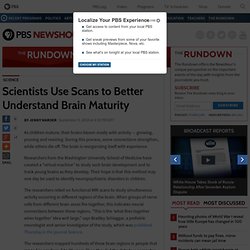
During this process, some connections strengthen, while others die off. The brain is reorganizing itself with experience. Researchers from the Washington University School of Medicine have created a “virtual machine” to study such brain development and to track young brains as they develop. Their hope is that this method may one day be used to identify neuropsychiatric disorders in children. The researchers relied on functional MRI scans to study simultaneous activity occurring in different regions of the brain. THE AMYGDALA AND THE EMOTIONS.
Chapter 9 — The Amygdala and the Emotions by Ben Best This installment is something of a digression in my "systematic" attempt to investigate the anatomical basis of mind.
LND – Laboratório de Neuropsicologia do Desenvolvimento da UFMG. The American Academy of Clinical Neuropsychology (theAACN.org) Instituto Internacional de Neurociência de Natal. Laboratório de Expressão Facial da Emoção. Neuropsychology Central. MRC CBU, Cambridge » Jessica Grahn. (compiled by Jessica Grahn) You can also use an interactive brain atlas.
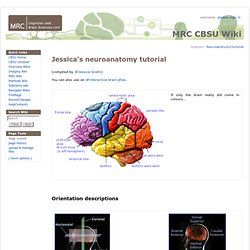
Orientation descriptions The AC / PC line The line joining the Anterior Commissure (AC) and Posterior Commissure (PC) The Cerebellum (Schmahmann, J.D., et al., Neuroimage, 1999, 10:233-260. ) The Basal Ganglia Caudate, putamen, and globus pallidus (also called pallidum by AAL template). The caudate, putamen, and ventral striatum (the most ventral outline) The Thalamus The Colliculi Superior colliculus and inferior colliculus. Brodmann Areas In the cortex, Brodmann areas are often used in conjunction with anatomical lables to help specify an area. Neuropsicologia - Neuroimagem em Neuropsicologia.