
To Get Students Invested, Involve Them in Decisions Big and Small. By Matt Levinson When asked why he became a scientist, Nobel Laureate Isidor Rabi attributed his success to his mother.

Every day, she would ask him the same question about his school day: “Did you ask a good question today?” “Asking good questions – made me become a scientist!” Rabi said. Questions are critical, and how to manage and navigate a good question requires practice. The hardest part about using design thinking in class is getting the question right and staying in the question.
Active Learning. 15-Yr-Old Kelvin Doe Wows M.I.T. "Noemt u dit lesgeven? Wat papieren uitdelen"
Systemthinking. The best way to learn marketing. The difference between a failure and a mistake. Amplify the positive outliers. Conference 2011: Key Insights on Idea Execution (Pt. III) More insights on making ideas happen from the 2011 edition of the 99U Conference…

Conference 2011: Key Insights on Idea Execution (Pt. II) More insights on making ideas happen from the 2011 edition of the 99U Conference…

Test Your Creativity: 5 Classic Creative Challenges. Fascinated by how brains and creativity work, we frequently share new research on the 99U twitter feed, showing how everything from drinking alcohol, to taking vacations, to moving your eyes from side to side can make you more creative.
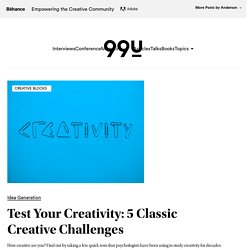
What’s particularly interesting, however, is that most of these studies rely on just a small group of core creativity tests – and you don’t need any special lab equipment to take them. Below, we’ve collected five of the most commonly used creativity challenges for your self-testing pleasure. While creativity “testing” is far from an exact science, trying your mettle at these challenges could yield insight into when, where, and how you’re most creative. Or maybe it’ll just be fun. 1. Developed by J.P. Hold papers togetherCufflinksEarringsImitation mini-tromboneThing you use to push that emergency restart button on your routerKeeping headphones from getting tangled upBookmark The test measures divergent thinking across four sub-categories: 5 Words You’ll Never Hear on the Campaign Trail. In this (and every) election year, I find myself amazed all over again at the phenomenal effort our elected and would-be elected officials put into the denial of their own mistakes.

Can I see your body of work? How to Write a Novel Using the Snowflake Method. Tools for creating ideas. Startups, This Is How Design Works. Simon Sinek: How great leaders inspire action. The Scientific Method in Psychology. How to Motivate People: Skip the Bonus and Give Them a Real Project.
Science has managed to reveal some crazy things that fly in the face of almost every commonly accepted management practice.
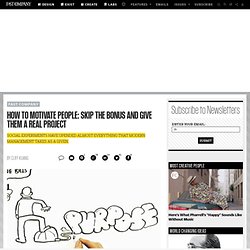
Here's the latest: Rewards for top performers lead them to worse performance. And if you want to foster innovation, bonuses won't work either. Rather, it's all about letting people slip from under line management and strike out on their own, on projects they care about. Dan Pink lays all that out in this new video, which illustrates a talk he gave at the RSA (a kind of British version of TED): Wild stuff, and all the more unsettling because of the current mess on Wall Street. The fact that science has also created a new vision for workplace performance--fueled less by management and more by individual goals--is shocking. How to Keep Kids Engaged in Class. Have you ever plunked yourself down in a staff meeting where some of your colleagues were, for lack of a better phrase, not paying attention?
Grading homework? Having private conversations? Texting? As we know all too well, kids aren't a whole lot different than adults: If they aren't absorbed by what's going on, they'll find something else that interests them. Getting all your students focused, eager, and on task at the beginning of class is challenging enough. Still, unless you manage to capture and keep students' focus, whether at the beginning of or midway through class, the engine of student learning that you are trying to drive simply isn't even in gear.
The Art of Complex Problem Solving. Education 2.0 – Social Networking and Education. In the last decade, the Internet has changed how teachers and students learn in the classroom.
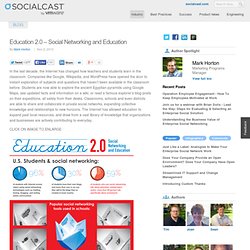
Companies like Google, Wikipedia, and WordPress have opened the door to instant exploration of subjects and questions that haven’t been available in the classroom before. Students are now able to explore the ancient Egyptian pyramids using Google Maps, see updated facts and information on a wiki, or read a famous explorer’s blog posts on their expeditions, all safely from their desks. Classrooms, schools and even districts are able to share and collaborate in private social networks, expanding collective knowledge and relationships to new horizons. The Internet has allowed education to expand past local resources, and draw from a vast library of knowledge that organizations and businesses are actively contributing to everyday.
With our culture’s shift to “social,” companies have created tools that offer free platforms for blogs, wikis and private social networking sites. Ken Robinson: Scholen doden de creativiteit. Making Ideas Happen.