
Dictionary - Index python dict by object or two floats. Python dictionary implementation. This post describes how dictionaries are implemented in the Python language.

Dictionaries are indexed by keys and they can be seen as associative arrays. Let’s add 3 key/value pairs to a dictionary: The values can be accessed this way: The key ‘d’ does not exist so a KeyError exception is raised. Hash tables Python dictionaries are implemented using hash tables. We are going to assume that we are using strings as keys for the rest of this post. If you run hash(‘a’) in Python, it will execute string_hash() and return 12416037344. If an array of size x is used to store the key/value pairs then we use a mask equal to x-1 to calculate the slot index of the pair in the array. We can see that the Python hash function does a good job when the keys are consecutive which is good because it is quite common to have this type of data to work with.
We could use a linked list to store the pairs having the same hash but it would increase the lookup time e.g. not O(1) average anymore. Open addressing. Python - Dictionary Data Type. A dictionary is mutable and is another container type that can store any number of Python objects, including other container types.
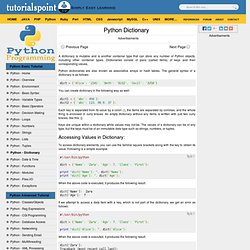
Dictionaries consist of pairs (called items) of keys and their corresponding values. Python dictionaries are also known as associative arrays or hash tables. The general syntax of a dictionary is as follows: You can create dictionary in the following way as well: Each key is separated from its value by a colon (:), the items are separated by commas, and the whole thing is enclosed in curly braces. Keys are unique within a dictionary while values may not be. Accessing Values in Dictionary: To access dictionary elements, you can use the familiar square brackets along with the key to obtain its value. When the above code is executed, it produces the following result: dict['Name']: Zara dict['Age']: 7 If we attempt to access a data item with a key, which is not part of the dictionary, we get an error as follows: Mappings and Dictionaries — Building Skills in Python. Many algorithms need to map a key to a data value.

This kind of mapping is supported by the Python dictionary, dict. We’ll look at dictionaries from a number of viewpoints: semantics, literal values, operations, comparison operators, statements, built-in functions and methods. We are then in a position to look at two applications of the dictionary. We’ll look at how Python uses dictionaries along with sequences to handle arbitrary connections of parameters to functions in Advanced Parameter Handling For Functions. This is a very sophisticated set of tools that let us define functions that are very flexible and easy to use. Dictionary Semantics A dictionary, called a dict, maps a key to a value. There is a subtle terminology issue here. Working with a dict is similar to working with a sequence. Unlike a sequence, a dict does not preserve order. Some Alternate Terminology.
Python List, Python Tuple, Python Dictionary. If a Python list were like a pencil, then a Python Tuple would be like a pen.
Most programming languages include structures in which you can hold a collection of values. The most frequent example you'll come across is called an "array" - but exactly what that does varies from language to language as a C array is very different to a Tcl array, for example. Python has FOUR (or five?) Object types built into the language that can be regarded as collections. Both LISTS and TUPLES consist of a number of objects which can be referenced by their position number within the object. So what's the difference? Link - complete example using a list Link - complete example using a tupleYou're probably wondering why the two structures are provided - are they both necessary?
If you're familiar with Perl hashes, PHP associative arrays or Tcl arrays, then you have a good parallel to a python dictionary.