
Mesopotamia: Science & Inventions. Glazed Bricks (Top) Clay, glaze Neo-Assyrian Period, reign of King Sargon II, ca. 721-705 B.C.
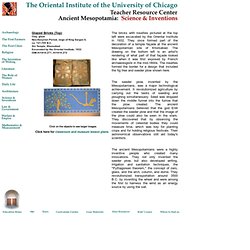
Sin Temple, Khorsabad Excavated by the Oriental Institute, 1932 OIM A11810.271, A11810.272 The bricks with rosettes pictured at the top left were excavated by the Oriental Institute in 1932. They once formed part of the decoration of a temple façade at the ancient Mesopotamian site of Khorsabad. The drawing on the bottom left is an artist's rendering of what part of that façade looked like when it was first exposed by French archaeologists in the mid-1800s. The rosettes formed the border for a design that included the fig tree and seeder plow shown here. The seeder plow, invented by the Mesopotamians, was a major technological achievement. The ancient Mesopotamians were a highly inventive people who created many innovations.
Ancient Assyria - Ancient Mesopotamia for Kids. At the same time that Babylon was rising to greatness in southern Mesopotamia, in Northern Mesopotamia another group was growing strong.
The Assyrians were a much more warlike people than the Babylonians. They were also known as great traders. Their caravans traveled all over the place, bringing goods to trade as well as food and wine to various cities in Mesopotamia. They worshiped the same gods as the people of Sumer and Babylon, but they had their own language. Since they were nomadic warriors, they lived a very different lifestyle then the Babylonians. The Assyrians were a very fierce people and soon conquered many nearby tribes and peoples. As the Assyrians waited, they grew stronger and conquered all the tribes and cities that supported and supplied Babylon.
Once their anger had ended and their revenge had been fulfilled the Assyrians looked back and thought. Art: The Assyrians did not create small statues like the Sumerians or Babylonians. Religion: The Assyrians lived in towns. Internet History Sourcebooks. Map of Ancient Mesopotamia, to 2500 BCE. Mesopotamia - The British Museum. Mesopotamia. Mesopotamia. Map showing the extent of Mesopotamia Mesopotamia (from the Ancient Greek: Μεσοποταμία: "[land] between rivers"; Arabic: بلاد الرافدين (bilād al-rāfidayn); Syriac: ܒܝܬ ܢܗܪܝܢ (Beth Nahrain): "land of rivers") is a name for the area of the Tigris–Euphrates river system, corresponding to modern-day Iraq, Kuwait, the northeastern section of Syria and to a much lesser extent southeastern Turkey and smaller parts of southwestern Iran.
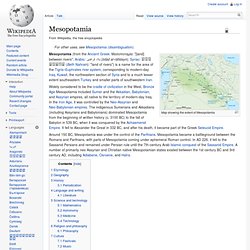
Widely considered to be the cradle of civilization in the West, Bronze Age Mesopotamia included Sumer and the Akkadian, Babylonian, and Assyrian empires, all native to the territory of modern-day Iraq. In the Iron Age, it was controlled by the Neo-Assyrian and Neo-Babylonian empires. Inventions - Ancient Mesopotamia for Kids. The Sumerians were very inventive people.
It is believed that they invented the sailboat and the chariot. For certain they developed cuneiform, the first written language. They developed a system of math that we still use in part today. They based their math on the number 60. Today, there are 360 degrees in a circle. The game of checkers invented at Ur Cylinder Seals Cuneiform - The First Written Language Gilgamesh - The First Super-Hero Hammurabi's Law Code - Written Down, and Applied to Everyone Hanging Gardens of Babylon (one of the 7 wonders of the world!)
Architectural Marvels See also: Ancient Inventions Explore Ancient Mesopotamia Stories & Games Daily Life, Government, Invention, Religion Free Sumer, Babylon, Assyria Clipart for Kids & Teachers Ancient Mesopotamia Lesson Plans for Teachers Free Presentations about Ancient Mesopotamia. Hammurabi's Code. As of July 1, 2013 ThinkQuest has been discontinued.

We would like to thank everyone for being a part of the ThinkQuest global community: Students - For your limitless creativity and innovation, which inspires us all. Teachers - For your passion in guiding students on their quest. Partners - For your unwavering support and evangelism. Ancient Mesopotamia for Kids - Sumer, Babylon, Assyria.