
Irish History, the story of the Irish Race. Gaelic & Celtic Myth. Title: Gaelic & Celtic Myth Post by: Nicole Jimmelson on February 03, 2007, 10:02:37 pm.
Tuatha De Danaan Family Tree. Cigányság. Myths & Facts. The History of the Roma Minority in the Czech Republic. Lebor Gabála Érenn. Lebor Gabála Érenn (The Book of the Taking of Ireland) is a collection of poems and prose narratives that purports to be a history of Ireland and the Irish from the creation of the world to the Middle Ages.
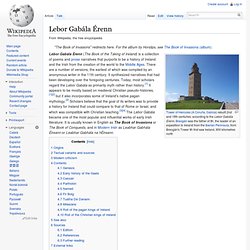
There are a number of versions, the earliest of which was compiled by an anonymous writer in the 11th century. It synthesized narratives that had been developing over the foregoing centuries. Today, most scholars regard the Lebor Gabála as primarily myth rather than history.[1] It appears to be mostly based on medieval Christian pseudo-histories,[1][2] but it also incorporates some of Ireland’s native pagan mythology.[2] Scholars believe that the goal of its writers was to provide a history for Ireland that could compare to that of Rome or Israel, and which was compatible with Christian teaching.[3][4] The Lebor Gabála became one of the most popular and influential works of early Irish literature.
The Library. Celtic Warrior Cuchulainn. The Celtic method of single combat in battle situations Although a large army of men and women set out to do battle, combat was primarily undertaken on a one to one basis.

Warriors were chosen from each side who would engage in combat with each other. The outcome would determine which side had won or lost. This was seen to be preferable to all out combat in which many lives were lost regardless of whoever was ultimately victorious. Timeline of Romani (Gypsy) History - 1 - Timeline of Romani (Gypsy) History - 2 - Roma and Gypsies. GypsyLinks. Zakono. Index. Milesians. Carpathian German History. The Carpathian Germans were a small German people living in the territory of today's Slovakia from the 12th century to 1945, when they suffered genocide.
This is the history, and the current doings, of the people I come from. This page is provided as a private volunteer public service. Roma and Gypsies. Dom Research Center - Internet Links. Church Slavonic Transliteration - Help Me Learn Church Slavonic. This is a transliteration table of the transliteration that I use on this site.
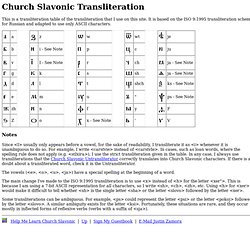
It is based on the ISO 9:1995 transliteration scheme for Russian and adapted to use only ASCII characters. Notes Since <I> usually only appears before a vowel, for the sake of readability, I transliterate it as <i> whenever it is unambiguous to do so. For example, I write <carstvie> instead of <carstvIe>. Carpathian German History. Index. Mother Of The Gods And The Father Of The Gael. There is no surviving, or as yet translated, Creation story within Irish mythology.
We learn from the Lebor Gabala Erenn, a text from the Christian Middle Ages, of the Tuatha De Danann, or "People of the Goddess Danu", who came to Ireland either from the sky or from islands to the north of the world. The Tuatha De Danann are presented as wizards who learned their skills in four cities, bringing with them four magickal treasures: the Stone of Fal, from Falias; the Spear of Lugh, from Gorias; the Sword of Nuada, from Findias; and the Cauldron of the Dagda, from Murias.(1) It is fairly well accepted amongst scholars of Irish mythology that the Tuatha De Danann are, in fact, Gods and Goddesses of the old religion of the Gaels.
The monks who transcribed the myths that have come down to us undoubtedly took liberties with certain aspects of those myths; it is our challenge to determine what is a Christianization, and what is a marker to the pathway of the older religion. 1. 2. 3. 4. Who are the Tuatha Dé Dannan. (Please note: My research regarding the Tuatha Dé Dannan is ongoing and if you notice some factual discrepancies in below text please feel free to let me know about them.
I'm living in South Africa and therefore doing research on a topic like the Tuatha can be quite challenging. Hope to hear from you... Blessed be.) Tuatha-De-Danann.
Resources « Lost Monongahela. You may find the following links to be useful when performing research about the Monongahela area.
(scroll down to the F.A.Q. section for tips on how to use several features of the Lost Monongahela website) Lost Monongahela on Google Maps Here is a map showing satellite images of different locations I have researched. I’ve added those Google “push pin” things so if you click on them, the map will zoom and you will see a written description of the subject. This feature is interactive and VERY cool. Monongahela City, Pennsylvania, 1902. This is an incredibly detailed drawing of Monongahela as it appeared around 1902. Szepes County - Megye - Varmegye - Placenames. The HUNGARIAN VILLAGE FINDER, ATLAS, and GAZETTEER for the KINGDOM of HUNGARY (HVF)- available for DOWNLOAD or on CD-ROM, lists and provides information for ALL of the following towns, villages, cities, places, settlements, and place names associated with Szepes County - megye - varmegye located in the old Austria-Hungary or Austro-Hungarian Empire, now in Poland and Slovakia.
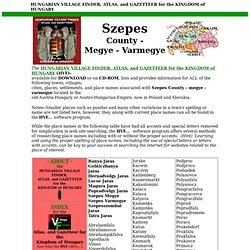
Notes--Smaller places such as pusztas and many other variations in a town's spelling or name are not listed here, however, they, along with current place names can all be found in the HVF... software program. Coal Miners Memorial, United Mine & Coke Works, United, Mt. Pleasant Twp., Westmoreland Co., PA, U.S.A. Report of the Department of Mines of Pennsylvania : Pennsylvania. Dept. of Mines. Coal Miners Memorial, Vesta Mines, California, Washington Co., PA, U.S.A. History of Saint Florian Slovak Catholic Church, United, Mt. Pleasant Twp., Westmoreland Co., PA, USA.
Following is a translation by Mr.
Stephen Ungvarsky; taken from a study by: Rev. Father Joseph A. Kushner, Decon, entitled, "Slovak Catholics of the Pittsburgh Diocese" and published by the "Slovak Catholic Sokol," Passaic, N. J., ca.1946. Camvinton11. Coal Miners Memorial. Gaelic. Carpatho-Rusyn Society. GERMANIC, PROTO-GERMANIC, TEUTONIC LINGUISTICS, CULTURE, MYTHOLOGY, HISTORY, INDO-EUROPEANS, ASATRU: THE INDO-EUROPEANS: BRIEF CHRONOLOGY OF THE METAL-AGES. Ancient Time Keepers, Part 3: Archaeoastronomy. Archaeoastronomy is the study of how people in the ancient past have understood and used the phenomena in the sky, and what role the sky played in their cultures. Ancient monuments and writings from around the world are undeniable proof that thousands of years ago people had advanced astronomical knowledge.
We propose that in fact all ancient sites of any major significance were constructed in order to allow astronomical observations and time tracking – and often, as the record/expression of their knowledge. In this article we explore connections of famous ancient sites to astronomy (Note: In Part 4 we explain ancient calendars and units of measure.) Englistory. Druidism Root & Its Fruits. Help in English. Linguistics - Indo-European. Language History. The Origins of Language We do not know when the first human language was created, although there are several popular theories of the origin of language. We do, however, know English's relationship to many other languages and we can chart its development back perhaps 4000 years to a language we call Indo European. The realisation of the surprising links between existing languages is a story in itself, which you can read here.
Look at a diagram of the Indo-European Language Family tree. Look at this timeline showing the origins of man and language. An analysis of the words shared by many languages and which we believe originated with Indo-European tells us something of the conditions and environment enjoyed by these early people. In simple terms we might think of these languages as tribes who moved away from the main original family and set up home for themselves in different parts of Europe. The Language Tree [Origin of Languages Diagram] Archeology. Myths and legends. Myth. Mythology & Religion. What destroyed the library of Alexandria? Les mystères anciens ont toujours passionné. Où se trouve Agadé, la capitale du grand Sargon d'Akkad, où a été inhumée la momie d'Alexandre le Grand, la papesse Anne a-t-elle existé ou plus récemment Hitler s'est-il vraiment suicidé ?
Autant de questions auxquelles ni l’archéologie ni les sources (fiabilité des écrits?) Ne peuvent clairement répondre. Et puis, il y a l'irrésistible théorie du complot ! Pour la bibliothèque d'Alexandrie nous avons des sources, des témoignages et même - en cherchant bien - quelques traces. Je suis en parti « rassuré » par le fait que la malheureuse bibliothèque, fondée par Ptolémée Ier, général macédonien et successeur d’Alexandre sur le trône d’Égypte au IVè siècle av. notre ère, a été plusieurs fois détruite.
Le premier accusé n'est autre que César. Le second accusé est un empereur chrétien, Théodose. Le dernier accusé est le calife Omar (584 – 644), un proche de Mahomet. Dimensional / Sacred Geometry. Saturnian Cosmology: Preface. The Fibonacci Sequence. Ancient Egypt. Karnak, Luxor and Abu Simbel pictures and history. The Gypsies. By the 1960s, Gypsy caravans were now mostly drawn with motorized vehicles, and tents had largely been replaced by rough shacks. Many took up residence in state supplied slum housing. Most Gypsies remained uneducated and illiterate. Many of the men became scrap dealers, and some worked with copper to produce ornamental, decorative pieces of art.
Gypsy women were still noted for fortune telling and begging. Some Gypsy children turned to shoplifting, picking pockets, and stealing from vehicles, since they were immune to prosecution. One would expect that Gypsy people would have fared well under Communist regimes, what with their stated philosophy of equality for all. There were 134,000 Gypsies in the Soviet Union in 1959; by the census of 1979 they numbered 209,000. Starting in the 1950s, Poland offered housing and employment to Gypsies, but most continued to wander. In Czechoslovakia, a law was passed in 1958 that forced Gypsies into settlements.
Women in the Ancient world. Secret Societies. Genesis Order of Druids. Rosicrucian. Illuminati. The Georgia Guidestones. Gov/Illuminati/Control. The Venus Project. Masonic. Moon Calendar.