
Computer Vision: Algorithms and Applications. © 2010 Richard Szeliski Welcome to the Web site ( for my computer vision textbook, which you can now purchase at a variety of locations, including Springer (SpringerLink, DOI), Amazon, and Barnes & Noble.
The book is also available in Chinese and Japanese (translated by Prof. Toru Tamaki). This book is largely based on the computer vision courses that I have co-taught at the University of Washington (2008, 2005, 2001) and Stanford (2003) with Steve Seitz and David Fleet. You are welcome to download the PDF from this Web site for personal use, but not to repost it on any other Web site. The PDFs should be enabled for commenting directly in your viewer. If you have any comments or feedback on the book, please send me e-mail.
This Web site will also eventually contain supplementary materials for the textbook, such as figures and images from the book, slides sets, pointers to software, and a bibliography. BackgroundSubtractionReview-Piccardi.pdf (application/pdf-Objekt) Nicolas Burrus Homepage - Kinect Calibration. Calibrating the depth and color camera Here is a preliminary semi-automatic way to calibrate the Kinect depth sensor and the rgb output to enable a mapping between them.
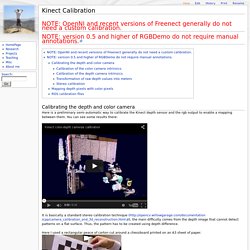
You can see some results there: It is basically a standard stereo calibration technique ( the main difficulty comes from the depth image that cannot detect patterns on a flat surface. Thus, the pattern has to be created using depth difference. Here I used a rectangular peace of carton cut around a chessboard printed on an A3 sheet of paper. Calibration of the color camera intrinsics The color camera intrinsics can be calibrated using standard chessboard recognition. Calibration of the depth camera intrinsics This is done by extracting the corners of the chessboard on the depth image and storing them. Transformation of raw depth values into meters. Code Laboratories > CL NUI Platform - Kinect Driver/SDK. Main Page. Hacking the Kinect - How to hack USB device drivers. Kinect_node. Windows Kinect Driver/SDK - CL NUI Platform Preview.
Hi Alex, and thank you for your work, was waiting for something like that, I installed the sdk and demo.
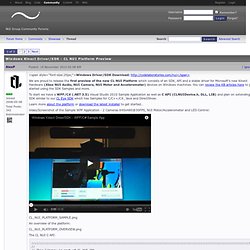
If anybody is goin to run into problems like described below, maybe you have installed previoulsy another version of NUI devices, so You need to remove all the software, then, from device manager, unistall and remove driver software for all the 3 NUI devices, reinstall CL sdk, and have fun :D // Crash case When starting the application I got a crash, if i do not stop the application i can see the GUI, control the motors&led and read accelerometer values, but i got black textures. it stops with this message : Description: Stopped working So i tried to recompile the solution with visualStudio 10, look like it recompile succesfully but if I start debug it stops in MainWindow.xaml.cs (85,16) where we have this line : CLNUIDevice.StartCamera(camera); debug stops here with this message ”Attempted to read or write protected memory. /// end of crash case :D Click thumbnail to see full-size image.
Welcome. Kinect - OpenSource [News] - amazing work created within a few days.. #of. There have been a number of exciting developments in the last few days related to XBox Kinect.
![Kinect - OpenSource [News] - amazing work created within a few days.. #of](http://cdn.pearltrees.com/s/pic/th/opensource-amazing-created-7414555)
For those that may not be aware of what it is, it’s a brand new interface to their Microsoft XBox games console. Kinect brings games without using a controller. By using projected infra-red light, the device is able to map the environment and via xbox built in software recognise gestures of any kind (see video below). Only few hours after the worldwide release of Kinect, guys at NUI Group, who posted results first, planed to only release the driver as open source once their $10k donation fund was filled up. In the meantime, Hector Martin performed a quick and hack of his own (three hours into the European launch) and released his results and code into the wild – named ‘libfreenect’.
Within a few hours of that Theo Watson ported it, making Kinect run from OSX for the first time. Memo Akten wrote a little demo to analyse the depth map for gestural 3D interaction. Kinect and Processing at daniel shiffman. This is all very preliminary, but here is a first pass as a Processing Kinect library: (Mac OSX only for now, sorry!)
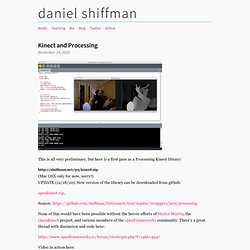
UPDATE (12/18/10): New version of the library can be downloaded from github: openkinect.zip. Source: None of this would have been possible without the heroic efforts of Hector Martin, the OpenKinect project, and various members of the openFrameworks community. Video in action here: Processing code looks like: import shiffman.kinect.*; PImage img;PImage depth; void setup() { size(640,240); NativeKinect.init(); img = createImage(640,480,RGB); depth = createImage(640,480,RGB);} void draw() { NativeKinect.update(); img.pixels = NativeKinect.getPixels(); img.updatePixels(); depth.pixels = NativeKinect.getDepthMap(); depth.updatePixels(); image(img,0,0,320,240); image(depth,320,0,320,240);} OpenKinect's libfreenect at master - GitHub. Kinect hacking news and community.