
UNIX / Linux Tutorial for Beginners. A beginners guide to the Unix and Linux operating system.
Eight simple tutorials which cover the basics of UNIX / Linux commands. Introduction to the UNIX Operating System What is UNIX? Files and processes The Directory Structure Starting an UNIX terminal Tutorial One Listing files and directories Making Directories Changing to a different Directory The directories . and .. Recommended UNIX and Linux books If you wish to continue learning Unix, here is a list of good Unix and Linux books, ranging from beginners to advanced. Download This tutorial is available for download so you can work offline.
LINUX. Tutorial. > Linux Reviews > A beginners guide to Linux for those with little or no computer experience.
Linux is a free Unix-type operating system for computer devices. The operating system is what makes the hardware work together with the software. The OS is the interface that allows you to do the things you want with your computer. Linux is freely available to everyone. Linux gives you a graphical interface that makes it easy to use your computer, yet it still allows those with know-how to change settings by adjusting 0 to 1. It is only the kernel that is named Linux, the rest of the OS are GNU tools. Linux is made with one thought in mind: Everything is a file.
A blank piece of paper is called a file in the world of computers. Beginner tutorials. How to enable exFAT in Ubuntu. Today’s modern filesystems were built with spinning-disk hard drives in mind.
This is true for Linux’s Ext2/3/4 Windows’ NTFS and server filesystems like XFS and ZFS. And of course so was the original FAT though it wasn’t so much optimised more simply being one of the first filesystems designed to address magnetic media. However it’s the simplicity of FAT that makes it attractive for the new generation of storage mediums based on flash memory. Usually flash memory devices (think SD/memory cards and USB keys) don’t have the fastest interfaces to the computer and any overhead a filesystem introduces simply slows it down. And because flash storage devices don’t often approach the volume of spinning-disk drives you don’t need advanced filesystems to handle them.
However while having served well for some time now FAT32 has its limitations too – mainly the inability to handle single files larger than 4GB. Which is all fine and dandy except that Linux can’t read exFAT volumes. ExFAT on Linux. Linux. Linux ( History[edit] Antecedents[edit] With AT&T being required to license the operating system's source code to anyone who asked (due to an earlier antitrust case forbidding them from entering the computer business),[23] Unix grew quickly and became widely adopted by academic institutions and businesses.
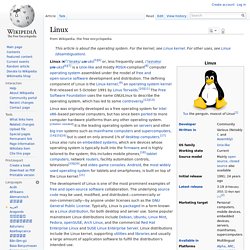
In 1984, AT&T divested itself of Bell Labs. Free of the legal obligation requiring free licensing, Bell Labs began selling Unix as a proprietary product. Linus Torvalds has said that if the GNU kernel had been available at the time (1991), he would not have decided to write his own.[26] Although not released until 1992 due to legal complications, development of 386BSD, from which NetBSD, OpenBSD and FreeBSD descended, predated that of Linux. MINIX, initially released in 1987, is an inexpensive minimal Unix-like operating system, designed for education in computer science, written by Andrew S. Creation[edit] Naming[edit] 5.25-inch floppy discs holding a very early version of Linux.