
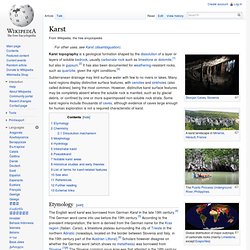
Witchs Finger Carlsbad Caverns.jpg - Wikipedia, the free encyclopedia. Karst. The karst hills of The Burren on the west coast of Ireland Karst topography is a geological formation shaped by the dissolution of a layer or layers of soluble bedrock, usually carbonate rock such as limestone or dolomite,[1] but also in gypsum.[2] It has also been documented for weathering-resistant rocks, such as quartzite, given the right conditions.[3] Subterranean drainage may limit surface water with few to no rivers or lakes.
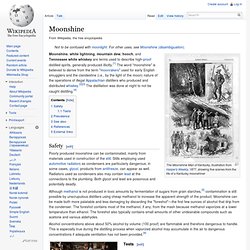
Many karst regions display distinctive surface features, with cenotes and sinkholes (also called dolines) being the most common. However, distinctive karst surface features may be completely absent where the soluble rock is mantled, such as by glacial debris, or confined by one or more superimposed non-soluble rock strata. Some karst regions include thousands of caves, although evidence of caves large enough for human exploration is not a required characteristic of karst. Etymology[edit] Chemistry[edit] Dissolution mechanism[edit] CaCO3 → Ca2+ + CO32– Moonshine. The Moonshine Man of Kentucky, illustration from Harper's Weekly, 1877, showing five scenes from the life of a Kentucky moonshiner Moonshine, white lightning, mountain dew, hooch, and Tennessee white whiskey are terms used to describe high-proof distilled spirits, generally produced illicitly.[1] The word "moonshine" is believed to derive from the term "moonrakers" used for early English smugglers and the clandestine (i.e., by the light of the moon) nature of the operations of illegal Appalachian distillers who produced and distributed whiskey.[2][3] The distillation was done at night to not be caught distilling.[4] Safety[edit] Although methanol is not produced in toxic amounts by fermentation of sugars from grain starches,[5] contamination is still possible by unscrupulous distillers using cheap methanol to increase the apparent strength of the product.
Alcohol concentrations above about 50% alcohol by volume (100 proof) are flammable and therefore dangerous to handle. List of fictional books. E pur si muove! Galileo Galilei, portrait by Justus Sustermans, 1636, National Maritime Museum, London.
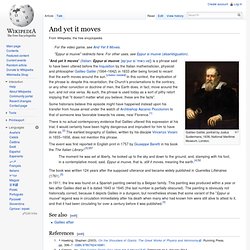
"And yet it moves" (Italian: Eppur si muove; [epˈpur si ˈmwɔːve]) is a phrase said to have been uttered before the Inquisition by the Italian mathematician, physicist and philosopher Galileo Galilei (1564–1642) in 1633 after being forced to recant that the earth moves around the sun. [citation needed] In this context, the implication of the phrase is: despite this recantation, the Church's proclamations to the contrary, or any other conviction or doctrine of men, the Earth does, in fact, move around the sun, and not vice versa. As such, the phrase is used today as a sort of pithy retort implying that "it doesn't matter what you believe; these are the facts". Some historians believe this episode might have happened instead upon his transfer from house arrest under the watch of Archbishop Ascanio Piccolomini to that of someone less favorable towards his views, near Florence.[1]
Statism. State, society and individuals[edit] Some analyses[who?]

[16] use a dichotomy between state and market, viewing the state as a homogeneous institution capable of using political power to force policy on the market which is the sum of peaceful human action. Such an analysis depends on an elitist theory of power rather than a pluralist theory of power; that power is exercised by individuals and competing organisations within society.[17] Authoritarianism, on the other hand, views a strong, authoritative state as required to legislate or enforce morality and cultural practices. [citation needed] The ideology of statism espoused by fascism holds that sovereignty is not vested in the people but in the nation state, and that all individuals and associations exist only to enhance the power, prestige and well-being of the state. Economic statism[edit] State interventionism[edit] State socialism[edit] State capitalism[edit] Statism may be used to refer to state capitalism.
Good articles. Buffalo buffalo Buffalo buffalo buffalo buffalo Buffalo buffalo. The sentence's meaning becomes clearer when it's understood that it uses three meanings of the word buffalo: the city of Buffalo, New York, the somewhat uncommon verb "to buffalo" (meaning "to bully or intimidate"), as well as the animal buffalo.

When the punctuation and grammar are expanded, the sentence could read as follows: "Buffalo buffalo that Buffalo buffalo buffalo, buffalo Buffalo buffalo. " The meaning becomes even clearer when synonyms are used: "Buffalo bison that other Buffalo bison bully, themselves bully Buffalo bison. " Sentence construction Bison engaged in a contest of dominance. This sentence supposes they have a history of such bullying with other buffalo, and they are from upstate New York. A comic explaining the concept The sentence is unpunctuated and uses three different readings of the word "buffalo". Marking each "buffalo" with its use as shown above gives: Buffaloa buffalon Buffaloa buffalon buffalov buffalov Buffaloa buffalon. Usage.